Lawn Flamingos
The Definition
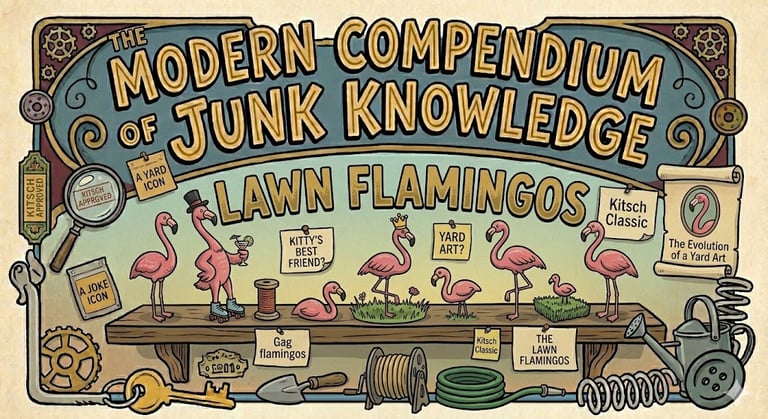
A pair of bright pink, hollow plastic garden ornaments shaped like flamingos, typically supported by thin metal legs. They are the ultimate symbol of American "kitsch"—decor so intentionally tacky or outdated that it becomes a statement of ironic cool or defiant suburban cheer.
The Deep Dive
The "junk knowledge" behind the pink flamingo is that it wasn't just a random toy; it was a carefully designed piece of industrial art intended to bring "tropical elegance" to the drab, post-war working-class suburbs. Created in 1957 by Don Featherstone, a designer for the company Union Products, the flamingo was a response to a specific cultural craving for the exotic.
The Plastic Revolution: In the 1950's, plastic was the "material of the future." Before the flamingo, garden ornaments were heavy, expensive, and made of cast iron or concrete. Featherstone’s use of injection-molded polyethylene made "art" affordable for the masses.
The Anatomy of a Pair: A genuine "Don Featherstone" flamingo always comes in a pair. One stands upright with its head high (the "sentinel"), while the other is bowed low as if feeding. This was a deliberate choice to create a narrative scene on a front lawn rather than a static object.
The Class War: By the 1960's and 70's, the pink flamingo became a battleground for taste. High-society critics viewed them as "low-class" or "tacky," leading to their banishment from many homeowners' associations. This rejection is exactly what fueled their second life as a symbol of rebellion and irony in the 1980's.
The flamingo reached its peak "junk" status when the city of Madison, Wisconsin, named it the official city bird in 2009. It represents the "junk" of the American Dream—an artificial, mass-produced bird that managed to become more iconic than the real animal it was modeled after.
Fast Facts
The Signature: Authentic flamingos produced by Union Products until 2006 carry Don Featherstone’s signature molded into the plastic under the tail. Collectors consider unsigned versions to be "unauthorized clones."
The "Flocking" Prank: "Flocking" is a popular fundraising tactic where a "victim's" lawn is covered with dozens or hundreds of pink flamingos overnight. The homeowner must then pay a small fee to a local charity to have the "infestation" removed and moved to a friend’s yard.
The IG Nobel Prize: In 1996, Don Featherstone was awarded the Ig Nobel Prize (a parody of the Nobel Prize for unusual or trivial achievements) in Art for his "ornamental evolutionary" contribution to the world.
References
Featherstone, D. (1999). The Original Pink Flamingo: A 40th Anniversary Celebration.
Price, J. (2006). The Flamingo Rising. (Exploring the cultural impact of suburban decor).
Ammer, C. (2013). The Dictionary of Clichés. Skyhorse Publishing.
The Smithsonian Magazine. (2012). The History of the Pink Flamingo.References