Left-Handed Compliment
The Definition
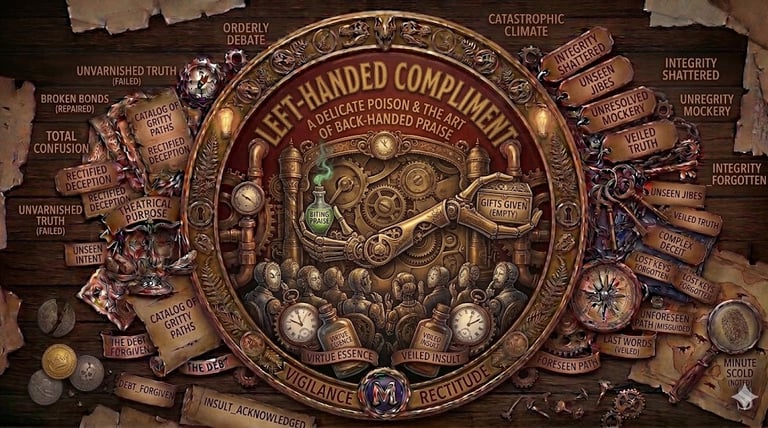
A "left-handed compliment" is a remark that seems like praise but actually contains an insult or a critical sting. It is a backhanded statement where the flattery is undermined by a subtle—or not so subtle—negative implication.
The Deep Dive
The origins of this phrase lie in a long history of cultural and linguistic bias against left-handedness, where the "left side" was systematically associated with dishonesty, clumsiness, or ill intent.
Sinister Origins: In Latin, the word for left is sinister, which evolved into the English word for "evil" or "threatening." Conversely, the word for right is dexter, the root of "dexterity" and "skill." Because the right hand was traditionally viewed as the hand of honor and truth, anything done with the left was seen as underhanded or insincere.
The "Bar Sinister": In heraldry and lineage, a "bar sinister" (a diagonal line on a coat of arms) was historically—though sometimes inaccurately—associated with illegitimacy. This reinforced the idea that the left side represented a deviation from the proper or "right" path. To give a compliment "left-handedly" was to deliver it with a hidden defect.
The Social Jab: By the 1800's, the phrase became a staple of social etiquette. A classic example would be telling someone, "You look so much better in person than you do in your photos." While it technically calls the person attractive, it simultaneously informs them that they are unphotogenic. It allows the speaker to deliver a blow while maintaining a thin veil of politeness.
Fast Facts
The "Backhanded" Rival: Today, "backhanded compliment" is the more common variation. It draws on the imagery of a tennis stroke or a slap delivered with the back of the hand rather than the palm.
Global Bias: This linguistic "left-handed" prejudice is found in many languages. In French, gauche means left, but it is also the word for "clumsy" or "socially awkward."
References
Ammer, C. (2013). The Dictionary of Clichés. Skyhorse Publishing.
Ayto, J. (1990). Dictionary of Word Origins. Arcade Publishing.
Oxford English Dictionary. (2026). The Etymology of Handedness and Social Deception.