Let Your Hair Down
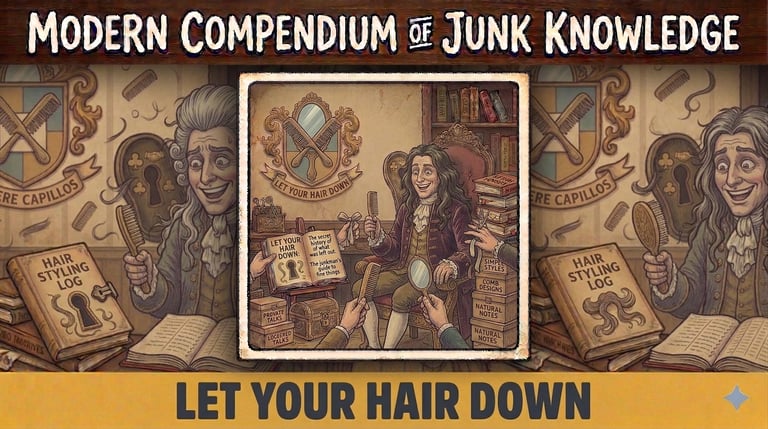
The Definition
To behave in a relaxed, uninhibited, or informal manner. It describes the transition from a "public persona"—guarded, professional, or socially proper—to a "private self" where one can speak freely and be at ease.
The Deep Dive
This is a literal piece of "junk knowledge" from the incredibly rigid social standards of 19th-century grooming. While we now use it for anyone taking off a tie or kicking off their shoes, the origin is rooted in the physical labor of a Victorian woman’s appearance.
In the 1800's, it was considered highly improper for a woman of status to appear in public with her hair loose. Long hair was seen as an intimate, almost scandalous feature.
The Architectural Up-Do: Every morning, a woman (often with the help of a lady's maid) would spend an hour or more pinning, braiding, and "architecting" her hair into elaborate buns, coils, and chignons. These styles were held together by dozens of heavy metal pins and combs.
The "Pinned" Stress: This wasn't just a fashion choice; it was a physical burden. The weight of the hair and pins could cause headaches and scalp tension. It was a constant reminder of the "upright" and "contained" behavior expected of her.
The Midnight Release: The only time a woman would "let her hair down" was at the very end of the day, in the privacy of her bedroom. It was the moment the "public mask" was removed along with the hairpins.
The phrase moved from a literal "unpinning" to a metaphorical "relaxing" by the early 20th century. It became a favorite of the Flapper era in the 1920's, as younger women began bobbing their hair entirely—a permanent, radical "letting down" of the old Victorian guard.
Fast Facts
The "Rapunzel" Link: In the fairy tale (first published by the Brothers Grimm in 1812), "Let down your hair" was a literal command for access. In the idiom, however, it’s a command for honesty.
The First Print: While the physical act is ancient, the figurative use ("we can all let our hair down now") didn't show up in major dictionaries or literature until the mid-1930's.
The "Hair" as Truth: Many cultures view hair as a repository of strength or spirit (like Samson in the Bible). To "let it down" is to reveal your true, unvarnished power.
References
Gernsheim, A. (1963). Victorian Fashion and Costume in Photographs. Dover Publications.
Ammer, C. (2013). The Dictionary of Clichés. Skyhorse Publishing.
Flexner, S. B. (1982). Listening to America. Simon & Schuster.
The Oxford English Dictionary. (2026). Hair (n.). Oxford University Press.