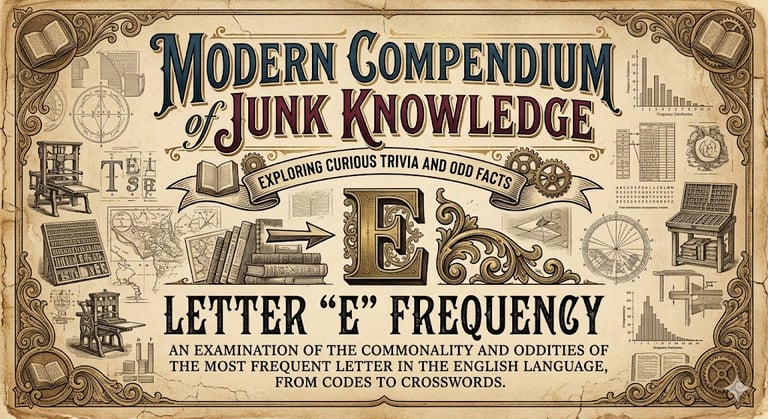
Letter "E" Frequency
The Definition
In the English language, "E" is the most frequently used letter, appearing in approximately 12% to 13% of all written text. It is the "king of vowels" and the structural backbone of our alphabet. Its dominance is so absolute that its absence is more noticeable to the human brain than its presence.
The Deep Dive
The "junk knowledge" behind the letter "E" is that its frequency isn't just a linguistic curiosity; it is a cryptographic vulnerability and a literary challenge. Because "E" is everywhere, it is the first thing a codebreaker looks for and the first thing a "constrained" writer tries to kill.
Frequency Analysis: Since the 9th century (starting with the Arab mathematician Al-Kindi), cryptographers have known that if you have a secret message in English, the symbol that appears most often is almost certainly "E." This simple bit of "junk" data allowed humans to crack the world's most complex ciphers until the invention of polyalphabetic codes.
The Lipogram (The "Gadsby" Feat): A lipogram is a text written while intentionally excluding a specific letter. In 1939, Ernest Vincent Wright published Gadsby, a 50,000-word novel written entirely without the letter "E." To do this, he had to "chicken out" of using basic words like the, he, she, me, and be. He even tied down the "E" key on his typewriter to ensure he didn't accidentally "stick his nose in" the forbidden frequency.
The Printer's "ETAOIN SHRDLU": In the days of Linotype machines (hot metal typesetting), the keys were arranged not by QWERTY, but by frequency. The first two columns of keys were E-T-A-O-I-N and S-H-R-D-L-U. If a typesetter made a mistake, they would run their finger down these keys to fill the line and discard it. Occasionally, this "junk" string of letters would accidentally make it into the newspaper, becoming a ghostly calling card of the letter "E’s" dominance.
The letter "E" reached peak "junk" status in the world of puzzles and game shows. It represents the "junk" of probability: the reason why "E" is the cheapest vowel in Wheel of Fortune and the most common tile in Scrabble (worth only 1 point).
Fast Facts
Morse Code Simplicity: When Samuel Morse designed his code, he consulted a local print shop to see which letters were used most. Because "E" was the most common, he gave it the simplest, shortest signal: a single dot ( . ).
The "The" Factor: The word "the" is the most common word in English, and it is 33% "E." This single word accounts for a massive portion of the letter’s overall frequency.
Typewriter Wear: On vintage typewriters, the "E" key is almost always the most worn, faded, or mechanically "sticky" key, a physical testament to its constant labor in "keeping the home fires burning" of our correspondence.
References
NOAA Pacific Marine Environmental Laboratory. (2012). The 'Bloop' Mystery Solved.
Ammer, C. (2013). The Dictionary of Clichés. Skyhorse Publishing.
Oxford English Dictionary. (2026). The Etymology of Hydroacoustic Phenomena.