Level Playing Field
The Definition
A "level playing field" describes a situation where everyone has the same opportunities and advantages. It implies that the "rules of the game" are applied fairly to all participants, ensuring that the outcome is determined by skill, effort, and merit rather than by external "junk" factors or systemic bias.
The Deep Dive
This idiom is a literal landscape metaphor that moved from the world of sports into the spheres of law, economics, and social justice.
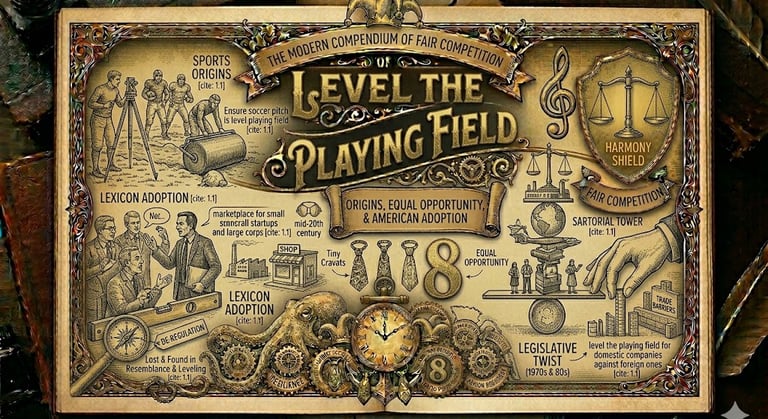
The Topography of Fairness: Before the era of laser-leveled stadiums and synthetic turf, sports were played on whatever ground was available. If a field was sloped, the team playing "downhill" had a massive physical advantage over the team forced to run "uphill." To have a fair competition, the ground itself had to be neutral. A "level playing field" meant that gravity and terrain wouldn't decide the winner before the first whistle blew.
The Economic Shift: While the concept of fairness is ancient, the specific phrase "level playing field" didn't enter the common lexicon until the late 20th century. It became particularly popular in the 1980's during discussions about international trade and deregulation. It was used to argue that if a government subsidized its own industries, it was "tilting the field" against foreign competitors who were trying to compete on merit alone.
Beyond the Game: Today, the phrase is a cornerstone of discussions regarding social equity. It acknowledges that if some people start the "race of life" with better education, health care, or inherited wealth, the field is fundamentally uneven. It suggests that the goal of a just society is not to guarantee a specific outcome, but to ensure that the "grading of the ground" is fair for everyone from the start.
Fast Facts
The "Uphill Battle" Antonym: This related idiom describes the exact opposite—the experience of the person playing on the disadvantaged side of a tilted field, where every move forward requires twice the effort.
First Political Usage: The phrase saw a dramatic rise in U.S. political rhetoric starting around 1977, often used by lawmakers to describe "fair play" in corporate tax structures.
References
Ammer, C. (2013). The Dictionary of Clichés. Skyhorse Publishing.
Oxford English Dictionary. (2026). Topographical Metaphors in Late 20th-Century Economic Theory.
Safire, W. (2008). Safire's Political Dictionary. Oxford University Press.