Library of Alexandria
The Definition
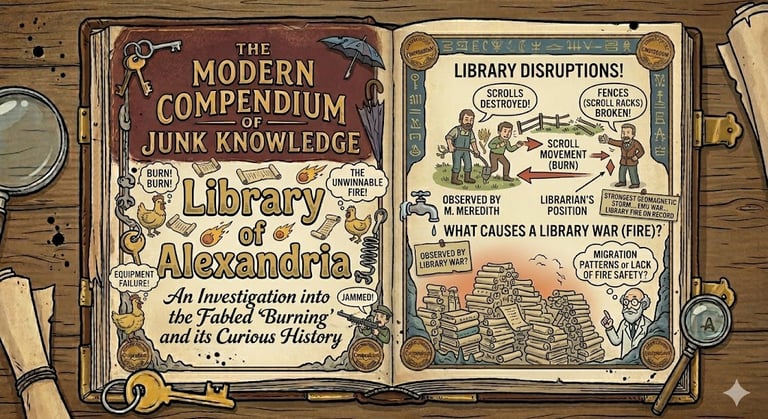
The most famous research institution of the ancient world, part of a larger complex called the Mouseion (Temple of the Muses) in Alexandria, Egypt. Founded in the 3rd century BCE, its goal was to house "all the knowledge of the world." While it is often remembered for its tragic destruction, it is more accurately defined as the birthplace of modern scholarship, where the principles of grammar, literary criticism, and scientific inquiry were first standardized.
The Deep Dive
The "junk knowledge" behind the Library of Alexandria is the popular belief that it was destroyed in a single, catastrophic fire that "set civilization back a thousand years." This narrative—while dramatic—is almost entirely a historical myth. In reality, the library didn't go out with a bang; it succumbed to a centuries-long "slow fade" caused by budget cuts, political instability, and the natural decay of papyrus.
The Caesar "Accident": The most famous fire occurred in 48 BCE when Julius Caesar set fire to his own ships to blockade the harbor. While some of the flames spread to the docks and reportedly destroyed roughly 40,000 scrolls, these were likely stored in nearby warehouses for export. The main library building survived and continued to function for centuries afterward.
The Ship Heist: The library’s collection grew through aggressive, almost "piratical" tactics. By decree of Ptolemy III, every ship that docked in Alexandria had to surrender its scrolls. Scribes would copy them, keep the originals, and return the copies to the owners. This ensured that while Alexandria had the best collection, it was rarely the only place where these texts existed.
The Scribe Problem: We didn't lose ancient knowledge because a building burned; we lost it because the Roman Empire collapsed and people stopped paying scribes to copy old books. Papyrus only lasts about 30 to 50 years in most climates before it rosettes or turns to dust. Without a continuous "army of scribes" to re-copy texts every few decades, the knowledge vanished through simple neglect.
The Library reached peak "junk" status in the modern era as a symbol of "lost utopia." It represents the "junk" of historical grief: our need to blame a single villain (like Caesar or religious mobs) for the loss of ancient literature, rather than acknowledging the boring, slow reality of economic decline and the fragility of paper.
Fast Facts
The First Librarians: The scholars at Alexandria invented the concept of the "alphabetical list" and the "table of contents." Before them, finding a specific passage in a pile of 500,000 scrolls was nearly impossible.
The "Daughter" Library: When the main Royal Library began to decline, a second, smaller collection was housed in the Serapeum temple. This "daughter library" was eventually destroyed in 391 CE during religious riots, marking one of the final blows to Alexandrian scholarship.
The Missing Plays: We know of 70 plays written by Aeschylus, but only 7 survive. While many assume they burned in Alexandria, most were simply "weeded out" over time by medieval teachers who only copied the most popular titles for their classrooms.
References
Canfora, L. (1987). The Vanished Library. University of California Press.
MacLeod, R. (2000). The Library of Alexandria: Centre of Learning in the Ancient World.
Tales of Times Forgotten. (2026). Misconceptions about the Library of Alexandria.