License to Print Money
The Definition
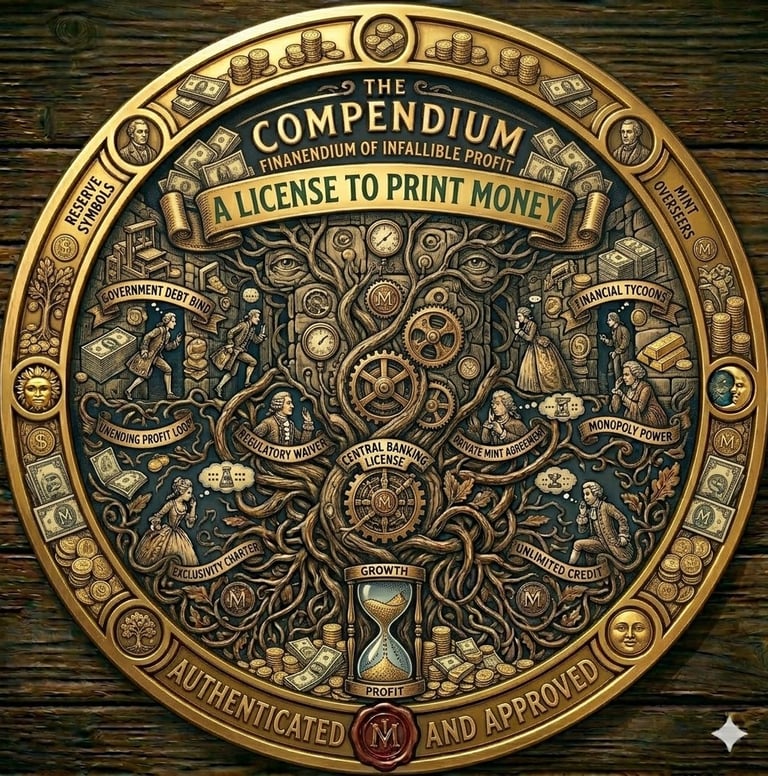
A colloquial idiom used to describe a business, investment, or opportunity that is so effortlessly and consistently profitable that it feels as though the owner has the legal authority of a national mint. It implies a situation where the "load" of effort is minimal, but the "output" of cash is massive and guaranteed.
The Deep Dive
The "junk knowledge" behind "a license to print money" is that it didn't originate in a bank or a stock exchange, but in a television studio. While humans have always sought effortless wealth, this specific phrase was coined by a man who had just "stepped into the boots" of a media mogul.
The Roy Thomson Quote (1957): The phrase is widely attributed to Lord Roy Thomson, a Canadian newspaper magnate. When he won the first commercial television franchise for Central Scotland (Scottish Television), he famously remarked to the press that having a commercial TV franchise was "a license to print money." At the time, television was so new and the advertising demand so high that he literally couldn't fail.
The Monopoly Factor: The core of a "license to print money" is usually a lack of competition. Whether it’s a government-sanctioned monopoly, a patented "junk" invention like the hula hoop at its peak, the "license" is the barrier that keeps others from "sticking their nose in" your profits.
The Irony of Real Printing: In reality, a literal license to print money (a contract to print currency for a government) is a low-margin, high-security headache involving microscopic "junk" details like watermarks and security threads. It is rarely, in itself, a "license to print money."
The phrase reached peak "junk" status in the 1980's and 90's, becoming the favorite descriptor for dot-com startups and tech monopolies. It represents the "junk" of the "Easy Street" dream: the belief that somewhere out there is a button you can press that makes the bank account go up while you "take a load off."
Fast Facts
The "Penny Dreadful" Connection: In the 19th century, publishers of cheap, sensationalist fiction (the "junk" food of literature) were said to have found a "gold mine." Thomson simply updated the metaphor for the electronic age.
The Digital License: Today, the phrase is often applied to software-as-a-service (SaaS) models or certain cryptocurrency "mining" operations—though as many found out in the "junk" coin crashes, sometimes the printer runs out of ink.
The "Tax" Alternative: To some economists, a "license to print money" is actually a regressive tax. If one entity has an effortless monopoly on a necessity, they aren't "printing" money so much as they are "extracting" it from the "kith and kin" of the general public.
References
Thomson, R. (1975). After I Was Sixty. (Autobiography).
Ammer, C. (2013). The Dictionary of Clichés. Skyhorse Publishing.
The Royal Mint Museum. (2026). The Economics of Currency Production.