Lindy Effect
The Definition
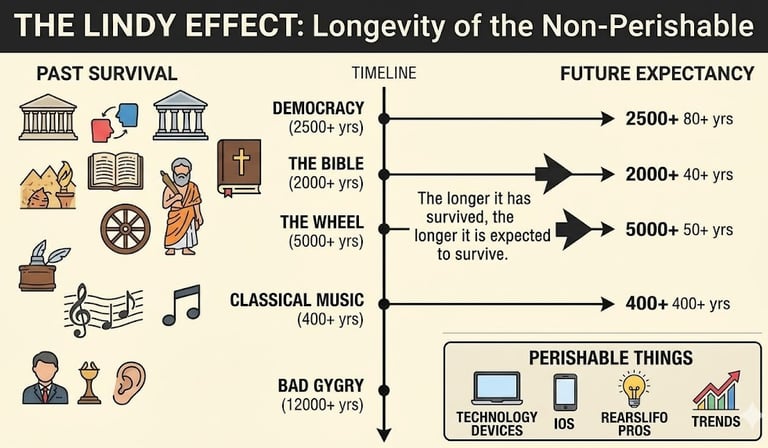
The Lindy Effect (or Lindy’s Law) is a concept in statistics and probability which suggests that for non-perishable things—like ideas, books, technologies, or artistic works—the future life expectancy is proportional to their current age. Unlike biological organisms that "age" and become more fragile, non-perishables "age in reverse." If a book has been in print for 50 years, the Lindy Effect predicts it will likely remain in print for another 50. If it survives another 10 years, its life expectancy actually increases to 60 more years.
The Deep Dive
The term has an origin story that started in a New York deli and was eventually formalized by some of the world's most famous mathematicians.
The Deli Origins (1964): The concept is named after Lindy’s Delicatessen in Manhattan, a legendary hangout for Broadway actors and comedians. In a 1964 article, Albert Goldman described a piece of "junk" folklore among the comedians: they believed that a performer’s career longevity was inversely proportional to their exposure. If a comedian did too much TV too fast, they’d be "used up" in weeks.
The Mandelbrot Refinement: Mathematician Benoit Mandelbrot (the father of fractals) took this deli gossip and gave it a mathematical skeleton. He realized that for certain things—those not limited by a physical lifespan—past survival is the best predictor of future survival.
The Taleb Popularization: The term became a cornerstone of modern "junk" knowledge thanks to Nassim Nicholas Taleb in his book Antifragile (2012). Taleb argues that time is a stressor that filters out the fragile. If an idea (like the Wheel or the Bible) has survived thousands of years of wars, cultural shifts, and technological changes, it is incredibly robust. A new smartphone app, however, is fragile; it hasn't stood the "test of time," so its life expectancy is tiny compared to a spoon or a hammer.
The Cheesecake Side-Note: Lindy’s itself was as famous for its cheesecake as it was for its career advice. It was the standard of New York desserts, immortalized as "Mindy's" in Damon Runyon’s stories and the musical Guys and Dolls. Ironically, while the original deli closed in 1969, the recipe for Lindy’s cheesecake has survived for over a century—a perfect example of the Lindy Effect in action.
Fast Facts
Non-Perishables Only: It’s crucial to remember that Lindy doesn’t apply to you. As a human, the older you get, the lower your remaining life expectancy. Lindy only applies to things that don't have an "absorbing barrier" (a natural expiration date).
Bitcoin and Gold: This is why "Lindy" is a favorite term in the crypto world. Critics argue Bitcoin is fragile because it's young (born 2009), while proponents argue that every year it survives without being hacked or banned, its "Lindy score" doubles. Gold, having been valuable for 5,000 years, is the ultimate Lindy asset.
References
Goldman, A. (1964). Lindy’s Law. The New Republic.
Taleb, N. N. (2012). Antifragile: Things That Gain from Disorder. Random House.
Mandelbrot, B. (1982). The Fractal Geometry of Nature. W. H. Freeman and Company.
Oxford English Dictionary. (2026). Probabilistic Heuristics in Post-Modern Economic Theory.