Listerine
The Definition
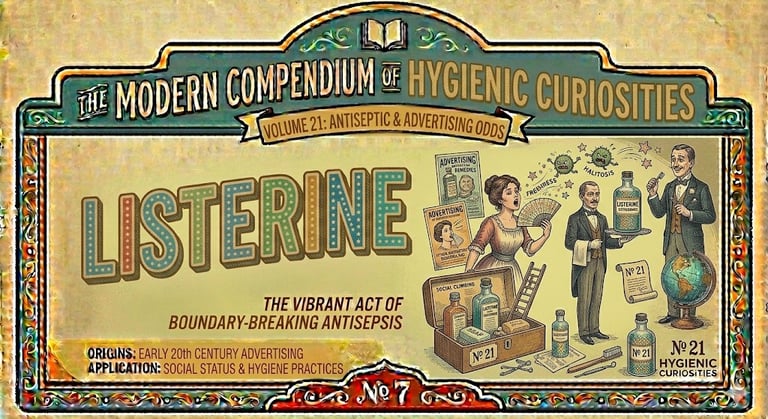
Listerine is a powerful antiseptic mouthwash that serves as the ultimate case study in "invented necessity." It is the product that transformed a common, minor social friction into a medical condition, effectively creating a multi-billion dollar market for oral hygiene where none had previously existed.
The Deep Dive
The history of Listerine is a "hot mess" of pivoting strategies, moving from the operating room to the janitor's closet before finally landing in the bathroom cabinet.
Surgical Origins: Formulated in 1879 by Dr. Joseph Lawrence and Jordan Wheat Lambert, the liquid was named in honor of Sir Joseph Lister, the British surgeon who pioneered antiseptic surgery. Originally, it was a high-strength surgical antiseptic designed to prevent infections in open wounds. It was essentially a tool for doctors, not consumers.
The "Junk" Utility Phase: In the late 19th and early 20th centuries, the manufacturers struggled to find a consistent mass-market use. It was sold, with varying degrees of success, as a floor cleaner, a treatment for dandruff, a deodorant, and even a supposed cure for gonorrhea. It was a product in search of a permanent identity.
The Halitosis Masterstroke: The real shift occurred in the 1920's. Gerard Lambert, the son of the founder, discovered the obscure Latin term halitosis (meaning "bad breath") in an old medical journal. He launched a revolutionary advertising campaign that framed bad breath as a socially ruinous medical ailment. The famous "Poor Edna" ads depicted a beautiful woman who could never get married because she suffered from this "condition" she didn't even know she had.
The Fear Factor: The campaign was one of the first to use "shame marketing." It suggested that your friends and lovers were whispering about you behind your back. Within just a few years, Listerine’s sales grew from roughly $100,000 to over $4 million. By medicalizing a natural human scent, they turned a floor cleaner into a daily essential.
Fast Facts
The "Burn" as a Benefit: The intense stinging sensation of original Listerine—caused by its high alcohol content and essential oils—was marketed as proof that it was "working." This helped distinguish it from "weaker" flavored rinses.
The "Generality" Escape: Unlike Kleenex, Listerine has managed to avoid becoming a generic term for mouthwash, largely because its distinct, medicinal taste and branding have kept it firmly identified as a unique product.
References
Lambert, G. B. (1956). All Out of Step: A Personal Chronicle. Doubleday.
Ammer, C. (2013). The Dictionary of Clichés. Skyhorse Publishing.
Oxford English Dictionary. (2026). The Medicalization of Social Graces in 20th-Century Advertising.