Living Beyond One's Means
The Definition
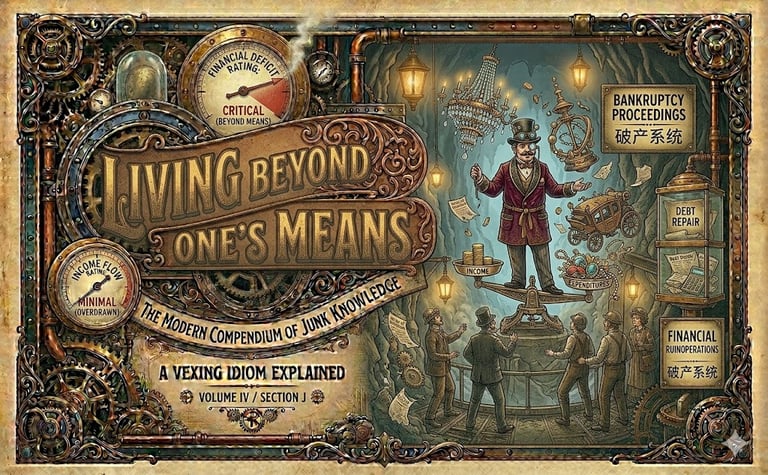
This phrase describes a lifestyle where a person's expenses exceed their income. It implies a reliance on debt or the depletion of savings to maintain a standard of living that is unsustainable in the long term.
The Deep Dive
The concept of "means" refers to the available resources—money, property, or credit—that a person has at their disposal. The idiom gained significant social weight during the Victorian era as a moral warning.
Fiscal Responsibility as Morality: In the 18th and 19th centuries, financial standing was closely tied to character. To live "beyond" those resources was seen not just as a mathematical error, but as a lack of self-discipline and integrity. It suggested that a person was more concerned with the appearance of wealth than the reality of their situation.
The Micawber Principle: Charles Dickens famously illustrated this concept through the character Wilkins Micawber in David Copperfield (1850). Micawber’s famous "recipe for happiness" was simple: "Annual income twenty pounds, annual expenditure nineteen nineteen and six, result happiness. Annual income twenty pounds, annual expenditure twenty pounds ought and six, result misery."
The Shift to Credit: In the mid-20th century, the rise of consumer credit and the "Keeping Up with the Joneses" mentality transformed the phrase. What was once a shameful secret became a systemic reality for many. Living beyond one's means transitioned from a term of social ruin to a common economic condition, though it still carries the warning of an inevitable financial reckoning.
Fast Facts
The "Means" Etymology: The word "means" comes from the Old French meien, meaning "middle" or "intermediate." In this context, it refers to the agency or instrument (wealth) used to achieve an end (a lifestyle).
The Safety Net: Historically, those who lived beyond their means without a family safety net often ended up in debtors' prison, a practice that was common in England until the Debtors Act of 1869.
References
Dickens, C. (1850). David Copperfield.
Ammer, C. (2013). The Dictionary of Clichés. Skyhorse Publishing.
Oxford English Dictionary. (2026). The Economic Morality of the Industrial Age.