Living the Life of Riley
The Definition
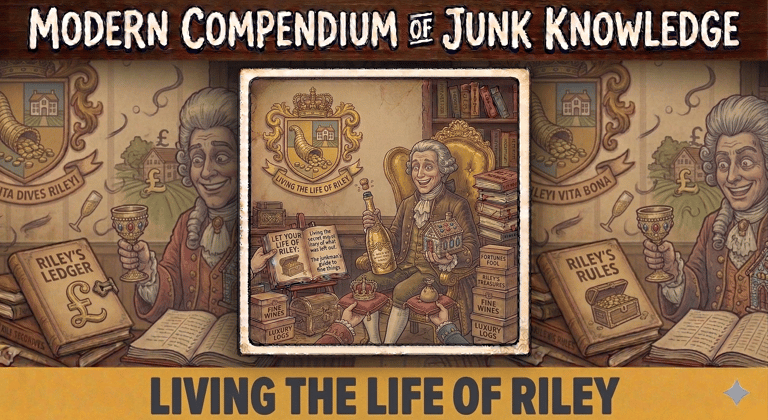
To live a life of carefree luxury, ease, and comfort, usually without having to work very hard for it. It implies that one has "made it" and is now simply coasting through a world of pleasant, worry-free days.
The Deep Dive
This is a "high-status" piece of junk knowledge that traces the American Dream through the evolution of pop culture—from 19th-century stage songs to the birth of the television sitcom.
The Musical Origins: While the exact "Riley" is debated, the phrase likely took root in the 1880's through popular vaudeville songs. The most famous was "Is That Mr. Reilly?" (1883) by Pat Rooney. The lyrics described a common man who imagined what he would do if he suddenly struck it rich: "Is that Mr. Reilly, can anyone tell? / Is that Mr. Reilly that owns the hotel? / Well, if that's Mr. Reilly they speak of so highly / Upon my soul, Riley, you're doing quite well."
The Irish-American Archetype: At the time, "Riley" (or Reilly) was the quintessential surname for the rising Irish-American working class. To live the "Life of Riley" was to transcend the grueling manual labor of the era and step into the shoes of the wealthy "shanty-to-lace-curtain" success story.
The Military Boost: The phrase gained massive traction during World War I. American soldiers (doughboys) used it in letters home to describe the rare moments when they had decent food, clean beds, and a break from the trenches. By the 1920's, it was a staple of the American lexicon.
The sentiment was immortalized for a new generation by the 1944 radio show (and later the 1950's TV series) The Life of Riley, starring William Bendix. Ironically, the character, Chester A. Riley, was a bumbling, blue-collar aircraft riveter whose life was anything but luxurious—he was famous for his catchphrase: "What a revoltin' development this is!" The show’s title was a sarcastic nod to the idiom, showing that for the average Joe, the "Life of Riley" was often a series of hilarious mishaps.
Fast Facts
The "Willy Reilly" Theory: Some etymologists point even further back to an 18th-century Irish ballad about Willy Reilly, a hero who eloped with a nobleman's daughter and eventually won his freedom and fortune.
The "Gleason" Connection: Before William Bendix took the role to TV, a young Jackie Gleason played Chester A. Riley in the first televised season (1949). It didn't quite click with audiences, and Bendix eventually returned to claim the character as his own.
The "Riley" as Adjective: In the early 20th century, if something was particularly "Riley," it meant it was top-notch or high-class.
References
Rooney, P. (1883). Is That Mr. Reilly? (Vaudeville sheet music).
Brecher, I. (1944). The Life of Riley. (Radio/TV series).
Ammer, C. (2013). The Dictionary of Clichés. Skyhorse Publishing.
The Oxford English Dictionary. (2026). Riley (n.). Oxford University Press.