London "Pea Soupers"
The Definition
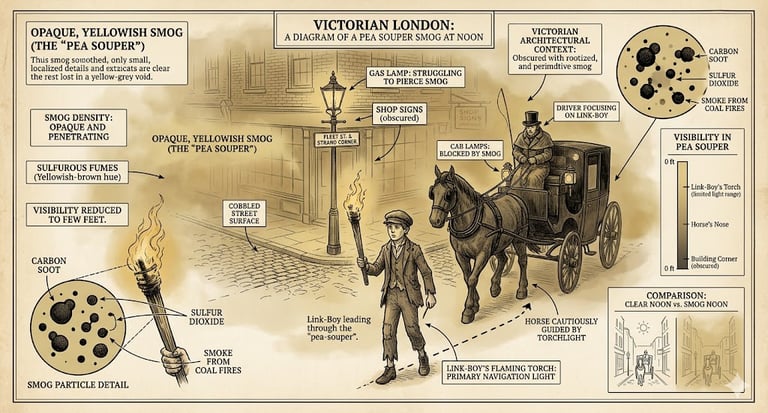
A "pea souper" (or pea soup fog) is an exceptionally thick, yellow-green, and suffocating smog that regularly blanketed London from the early 19th century until the mid-20th century. Rather than a natural weather event, a pea souper was a severe man-made environmental hazard caused by industrialization, urban density, and the massive, unchecked burning of soft bituminous coal.
The Deep Dive
The term captures a dark era of urban growth where the romanticized "London fog" of Victorian literature was, in reality, a toxic, foul-smelling chemical soup.
The Culinary Analogy: The nickname was derived from the fog’s distinct, murky yellow-green coloration and its incredibly dense, opaque consistency, which closely mirrored a thick bowl of split pea soup. In a classic bit of cultural feedback, London restaurants began naming their thickest green pea and ham hock soups "London Particulars"—borrowing a phrase popularized by Charles Dickens in his 1853 masterpiece Bleak House to describe the city's unique atmospheric afflictions.
The Chemical Composition: Unlike clean, damp country mists, a true pea souper was a bone-dry, acrid aerosol. As millions of domestic hearths and factory smoke-stacks burned cheap "sea-coal," they released massive quantities of tarry soot particulates and poisonous sulfur dioxide gas. When a natural weather phenomenon known as a temperature inversion trapped cold air in the Thames Valley under a lid of warm air, these soot particles became coated in sulfurous moisture, turning the air into a dry, pungent, and highly acidic blanket.
The Theater of Urban Chaos: When a pea souper descended, the city ground to an absolute halt. The visibility was frequently reduced to less than a single yard, forcing omnibuses to be abandoned in the middle of crossings. Citizens had to hire "link-boys"—impoverished youths carrying burning torches—to guide them through the midday darkness. The blanketing silence and zero visibility provided the perfect cover for thieves and pickpockets, turning the city into a surreal, lawless landscape that heavily inspired the gothic atmospheres of Sherlock Holmes stories and Strange Case of Dr Jekyll and Mr Hyde.
The Lethal Climax: For decades, the fogs were treated as an inevitable price of industrial progress. However, the true lethality of the phenomenon was exposed during the Great Smog of London in December 1952. Over five days, a massive “pea souper” killed an estimated 4,000 to 12,000 people from acute bronchitis and respiratory failure. The sheer scale of the medical disaster finally broke the political inertia, leading directly to the passage of the Clean Air Act 1956, which banned the burning of soft coal in designated urban areas and permanently erased the historic pea souper from the London skyline.
Fast Facts
The 30-Cigarette Walk: At the height of a late-Victorian winter fog, contemporaries estimated that taking a short 30-second walk down Bond Street exposed a person's lungs to the equivalent pollutant volume of smoking 20 to 30 cigarettes.
Monet’s Muse: The famous French Impressionist artist Claude Monet traveled to London specifically during the winters of 1899 to 1901 to paint the Thames. He was utterly captivated by the pea soupers, famously stating that without the unique, soot-laden fog, "London wouldn't be a beautiful city. It's the fog that gives it its magnificent breadth."
References
Corton, C. L. (2015). London Fog: The Biography. Harvard University Press.
Evelyn, J. (1661). Fumifugium: or, The Inconvenience of the Aer, and Smoake of London Dissipated. (The earliest major treatise protesting coal pollution).
Oxford English Dictionary. (2026). The Etymology of Urban Environmental Idioms and Industrial Smogs.