Loneliest Whale in the World
The Definition
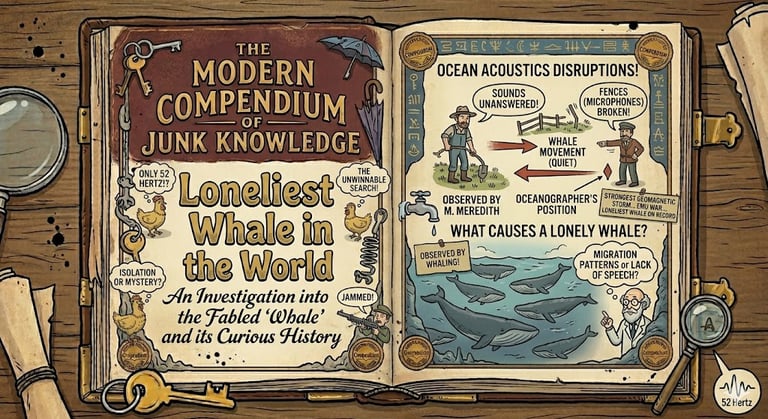
Known as "52 Blue," this is an individual whale of an unidentified species that calls at the unusual frequency of 52 Hertz. Because this frequency is significantly higher than that of other whales (such as Blue whales or Fin whales), it is widely believed that other whales cannot hear or understand it, leading to its reputation as the most solitary creature on Earth.
The Deep Dive
The "junk knowledge" behind the Loneliest Whale is that its "loneliness" is a human projection—we’ve turned a biological anomaly into a global metaphor for isolation. The whale was first detected in 1989 by the U.S. Navy’s SOSUS (Sound Surveillance System), a massive underwater microphone network designed to track Soviet submarines during the Cold War.
The Frequency Mismatch: Most Blue whales vocalize in the 10–39 Hz range, while Fin whales call around 20 Hz. At 52 Hz, the whale’s song is roughly the frequency of the lowest note on a tuba. To other whales, 52 Blue might sound like a high-pitched, unintelligible squeak, or it might fall outside their auditory range entirely.
The Species Mystery: No human has ever seen 52 Blue. It has only ever been "seen" through its acoustic signature. Scientists speculate it could be a hybrid—perhaps the offspring of a Blue whale and a Fin whale—which would explain its unique vocalizations and its migratory patterns, which don't quite match any known species.
The Persistence of Hope: Despite its "loneliness," the whale is remarkably resilient. It has been tracked moving through the Pacific Ocean every year for over three decades. It doesn't follow a pod; it travels alone, calling out into the deep, apparently healthy and surviving without the social structure typical of large cetaceans.
52 Blue reached peak "junk" status in the 2010's, inspiring countless songs, poems, and a documentary produced by Leonardo DiCaprio. It represents the "junk" of anthropomorphism: our deep-seated need to find a reflection of our own existential solitude in the natural world.
Fast Facts
The "Twin" Theory: In 2010, sensors off the coast of California picked up two different 52 Hz calls at the same time. This has led some scientists to believe that 52 Blue might not be alone—there could be a small group or even a new, undocumented species that shares this unique "language."
The Navy's Gift: We only know about this whale because of the declassification of Navy technology. Without the Cold War's need for silent submarine tracking, the song of 52 Blue would have remained a secret of the deep forever.
Non-Stop Singing: During the mating season, the whale has been known to call continuously for hours, a Herculean effort that suggests it is actively seeking a mate, unaware that it is broadcasting on a frequency no one else is using.
References
Watkins, W. A., et al. (2004). 20 Years of Shelving: A 52-Hz Whale in the Northeast Pacific. Oceanography.
The New York Times. (2021). The Search for 52: The World's Loneliest Whale.
Navy Undersea Warfare Center. (2026). Acoustic Surveillance and Marine Mammal Monitoring.