Mad as a Hatter
The Definition
Completely insane, eccentric, or behaving in a dangerously erratic manner. It describes someone whose mental state has detached from reality, often characterized by tremors, slurred speech, and wild mood swings.
The Deep Dive
While most people associate this phrase with the tea-drinking character in Lewis Carroll’s Alice's Adventures in Wonderland, the "junk knowledge" behind it is a grim reality of 18th and 19th-century manufacturing.
Before the invention of synthetic materials, high-quality felt hats (like top hats and bowlers) were made from the fur of small animals like rabbits and beavers.
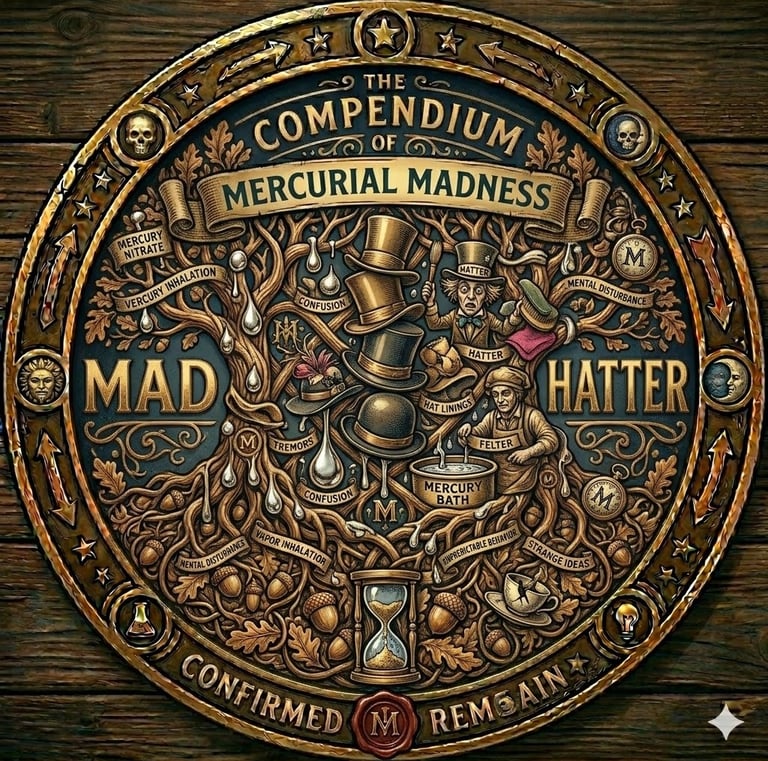
The Process of "Carrotting": To turn stiff fur into soft, pliable felt, hatters used a solution of mercuric nitrate. This process was called "carrotting" because the mercury turned the white fur a distinct orange color.
The Toxic Vapor: Hatters worked in poorly ventilated rooms, breathing in mercury fumes and absorbing the metal through their skin for hours every day.
Erethism (The "Madness"): Chronic mercury poisoning leads to a neurological condition called erethism mercurialis. The symptoms included "The Danbury Shakes" (intense tremors), extreme social anxiety, pathological shyness, and sudden bursts of irritability or confusion. To an outside observer, the hatter appeared to have "gone mad."
The phrase "mad as a hatter" was already common in English by the 1830's, decades before Carroll wrote his book. In fact, the character of the Mad Hatter was likely based on Theophilus Carter, an eccentric furniture dealer in Oxford who was known for wearing a top hat and having "invented" an alarm clock bed that dumped the sleeper onto the floor.
Fast Facts
The "Danbury Shakes": Danbury, Connecticut, was the hat-making capital of the world in the 19th century. The mercury-induced tremors were so common there that they were named after the city.
The Mercury Ghost: Mercury poisoning doesn't just go away. Some historians believe that "haunted" old hat factories were actually just buildings where the floorboards were still off-gassing mercury vapors, causing visitors to experience hallucinations and anxiety.
The "March Hare" Link: This is a linguistic cousin to "mad as a March hare," which refers to the erratic "boxing" behavior of hares during their spring mating season.
References
Carroll, L. (1865). Alice's Adventures in Wonderland.
Wedeen, R. P. (1984). Poison in the Pot: The Legacy of Lead and Mercury. Southern Illinois University Press.
Ammer, C. (2013). The Dictionary of Clichés. Skyhorse Publishing.
The Oxford English Dictionary. (2026). Hatter (n.) and Mad (adj.). Oxford University Press.