Magic 8-Ball
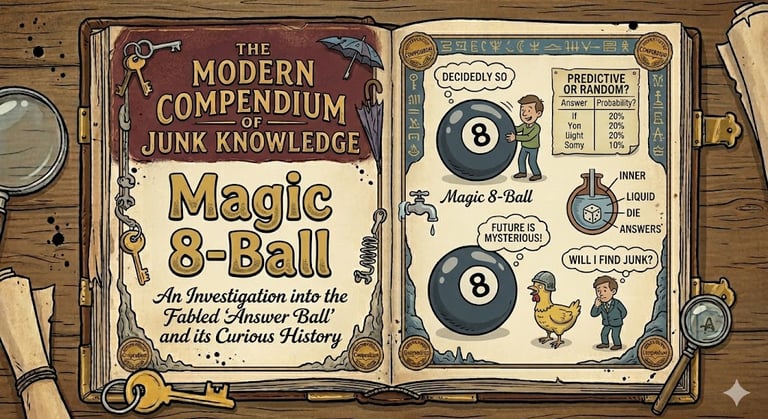
The Definition
A hollow, plastic sphere resembling an oversized black-and-white 8-ball, used for fortune-telling or seeking advice. By shaking the ball and turning it over, a user reveals a 20-sided die floating in dark blue liquid, which displays one of twenty possible answers to a "yes-or-no" question.
The Deep Dive
The "junk knowledge" behind the Magic 8-Ball is its origin as a failed clairvoyant tool created by the son of a professional psychic. In the 1940's, Albert Carter—whose mother Mary was a well-known seer in Cincinnati—invented a device called the "Syco-Slate."
The Syco-Slate: Carter’s original design was a cylinder, not a ball. It featured two glass ends and was filled with a thick, murky liquid. When flipped, a pair of dice would float to the surface to reveal an answer.
The Liquid Problem: The early models were prone to leaking and the liquid often became too dark to read. After Carter passed away in 1948, his business partner Abe Bookman refined the design. To make it more marketable, he placed the mechanism inside a crystal ball.
The Brunswick Pivot: The transition to the "8-Ball" happened in 1950. The Brunswick Billiards company was looking for a promotional item and suggested that the mechanism be housed in a billiard ball. The stark, iconic look of the black 8-ball (the most "mysterious" ball on the table) was an instant hit.
The Magic 8-Ball reached peak "junk" status in the 1960's when Mattel acquired the rights and turned it into a global toy phenomenon. It represents the "junk" of probability: a device that provides the illusion of cosmic wisdom through a simple, random icosahedron submerged in blue-dyed alcohol and water.
Fast Facts
The Twenty Answers: The die inside is a regular icosahedron. It contains 10 "Affirmative" answers (e.g., Signs point to yes), 5 "Negative" answers (e.g., My sources say no), and 5 "Non-committal" answers (e.g., Reply hazy, try again).
The "Blue" Secret: The liquid inside is actually alcohol (typically isopropanol) dyed with a dark blue pigment. Alcohol is used because it doesn't freeze easily and has a low surface tension, allowing the die to move smoothly without sticking to the glass.
The Bubble Trouble: If you see a bubble at the window instead of an answer, it’s usually due to a "leak" or air being trapped over time. In "junk" lore, a bubble is sometimes jokingly referred to as a sign that the spirits are "unclear" or "unavailable."
References
Bookman, A. (1950). U.S. Patent No. 2,452,730: Liquid-filled Dice Agitator.
Mattel, Inc. (2026). The History of the Magic 8-Ball.
Walsh, T. (2005). Timeless Toys: Classic Toys and the Playmakers Who Created Them. Andrews McMeel Publishing.