Melting Point of a Diamond
The Definition
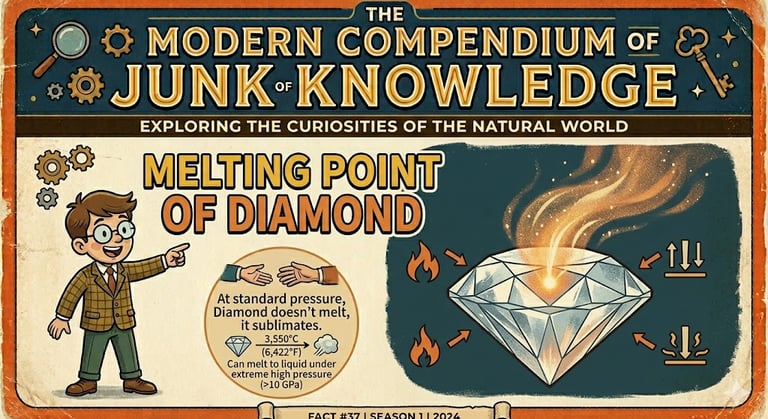
The melting point of a diamond is approximately 4,027°C (7,280°F) at a pressure of about 100 atmospheres. However, under standard atmospheric pressure on Earth, a diamond doesn't actually "melt" in the traditional sense; it undergoes sublimation or turns into graphite before it can ever become a liquid.
The Deep Dive
The "junk knowledge" behind the melting of a diamond is that it is one of the hardest substances to turn into a "puddle" because of its covalent network lattice. In a diamond, every carbon atom is bonded to four others in a perfect tetrahedron, creating a structural "integrity" that resists heat with stubborn intensity.
The Graphite Shift: If you heat a diamond in the presence of oxygen, it will simply catch fire and turn into carbon dioxide around 700°C. If you heat it in a vacuum to prevent burning, the diamond will eventually realize it is in a "low pressure" environment and "chicken out" of being a diamond, rearranging its atoms into graphite (the "junk" carbon in your pencil) long before it reaches its melting point.
The "Liquid Carbon" Ocean: To actually see liquid diamond, you need extreme pressure—about 10 million times Earth's atmospheric pressure. Scientists believe that on "ice giant" planets like Uranus and Neptune, there are literally oceans of liquid carbon with solid "diamond icebergs" floating in them.
The Triple Point: The point where solid diamond, graphite, and liquid carbon can coexist is a specific "coordinate" in physics known as the triple point. For carbon, this requires temperatures around 4,500 K and pressures exceeding 10 GPa.
The melting point of diamond reached peak "junk" status in the world of high-pressure physics experiments. It represents the extremes: the fact that the most "permanent" gemstone on Earth is actually just a high-pressure phase that is "dying" to turn back into charcoal.
Fast Facts
The "Burning" Diamond: In 1772, Antoine Lavoisier used a giant magnifying glass to focus sunlight on a diamond in a glass jar. He proved it was made of carbon because it disappeared completely, leaving behind only carbon dioxide gas.
Hardness vs. Toughness: While a diamond has a massive melting point and is "hard" (resistant to scratching), it is not "tough." You can "give the axe" to a diamond with a simple household hammer because its crystal planes are brittle and will shatter upon impact.
Industrial Cooling: Because diamonds have incredible thermal conductivity (better than copper), they are often used in high-end electronics as "heat sinks" to keep microchips from reaching their own melting points.
References
Lavoisier, A. (1772). Experiments on the Nature of the Diamond.
Eggert, J. H., et al. (2010). Melting Temperature of Diamond at Ultrahigh Pressure. Nature Physics.
Hazen, R. M. (1999). The Diamond Makers. Cambridge University Press.