Microwave
The Definition
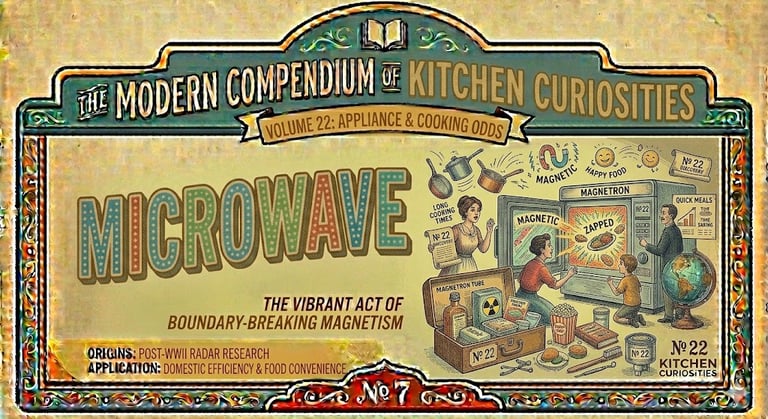
The microwave oven is a kitchen appliance that uses electromagnetic radiation in the microwave frequency range to heat food. It is perhaps the most famous example of a military technology that was accidentally repurposed for domestic convenience, transforming how the world approaches meal preparation.
The Deep Dive
The invention of the microwave was not a planned scientific endeavor but a result of a messy, unexpected observation during World War II.
The Radar Connection: In 1945, self-taught engineer Percy Spencer was working for Raytheon, focusing on improving magnetron tubes—the core component of radar sets used to detect enemy aircraft. These tubes emitted high-frequency radio waves.
The Melting Treat: While standing near an active magnetron, Spencer noticed something strange: a peanut cluster bar (or a chocolate bar, depending on the version of the legend) in his pocket had completely melted. Rather than dismissing it as a "hot mess," he grew curious. He began experimenting by placing popcorn kernels and eventually an egg near the tube. The kernels popped instantly, and the egg famously exploded.
The Radarange: Recognizing the potential for rapid cooking, Raytheon patented the technology in 1945. The first commercial unit, released in 1947, was dubbed the "Radarange." It was a gargantuan piece of "junk" by modern standards—standing six feet tall, weighing 750 pounds, and costing roughly $5,000 (over $60,000 in today's currency). It was primarily used by restaurants and ocean liners.
The Countertop Revolution: It took decades for the technology to shrink in both size and price. It wasn't until 1967 that the first affordable countertop model (the Amana Radarange) was released for around $500. By the late 1970's, as the efficiency of the device became undeniable, it moved from a luxury curiosity to a household essential.
Fast Facts
The "Micro" Etymology: The term "microwave" was coined in 1931 to describe electromagnetic waves with a wavelength shorter than standard radio waves but longer than infrared. It wasn't used as a verb for cooking until the mid-1970's.
The Accidental Nature: Percy Spencer had no background in food science; his discovery is often cited alongside Velcro and Penicillin as one of the most significant accidental inventions in history.
References
Carlisle, R. (2004). Scientific American Inventions and Discoveries. John Wiley & Sons.
Ammer, C. (2013). The Dictionary of Clichés. Skyhorse Publishing.
Oxford English Dictionary. (2026). The Military-Industrial Origins of Domestic Appliances.