Midwest Goodbye
The Definition
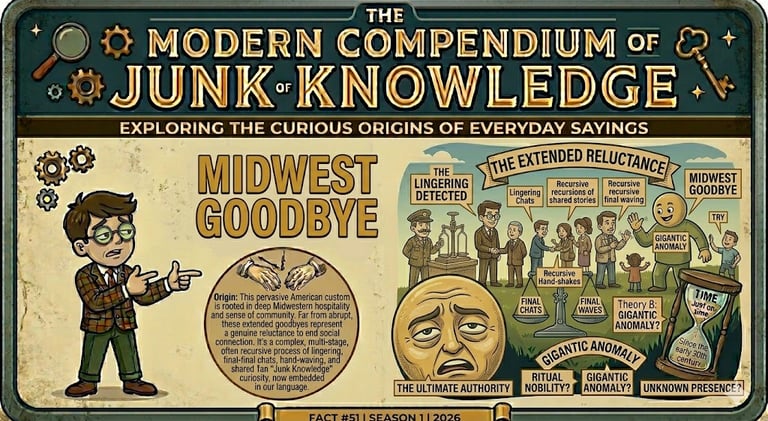
The "Midwest goodbye" is a highly structured, multi-stage cultural ritual practiced in the American Middle West, whereby the simple act of leaving a social gathering is prolonged over an extended period—often lasting anywhere from thirty minutes to upwards of two hours. Characterized by an intricate sequence of physical shifts, conversational resurges, and doorstep hospitality, the ritual is an unyielding demonstration of politeness, where abruptly walking out the door is viewed as a severe social offense.
The Deep Dive
The phenomenon is a masterclass in regional sociology, transforming a simple departure into a complex, comforting, and occasionally exhausting tribal dance.
The Anatomy of the Departure: A classic Midwest goodbye is entirely predictable and follows a strict, non-linear chronological timeline:
Stage 1: The Thigh Slap (The Catalyst): The ritual officially begins when a guest seated on a couch or at a kitchen table firmly slaps both thighs, lets out a rhythmic sigh, and utters the sacred opening incantation: "Welp, I spose..." or "Look at the time, we should probably get going."
Stage 2: The Kitchen Counter Transition: Instead of walking to the exit, the host and guest rise and move to the kitchen or hallway, where a completely new, often deeper conversation erupts. This phase can easily last twenty minutes, touching on local news, weather forecasts, or family updates.
Stage 3: The Front Door Stand: The party migrates to the literal threshold of the home. With coats half-on and keys visibly in hand, the group stands in the open doorway—frequently letting out cold air or attracting bugs—to trade another round of anecdotes and finalize future plans.
Stage 4: The Driveway Climax: The host walks the guest all the way to their vehicle. Conversing through a rolled-down car window is highly encouraged.
Stage 5: The Porch Wave: As the guest finally pulls away, the host remains stationary on the porch, waving continuously until the taillights completely disappear around the corner.
The Cultural Engine: Sociologists note that the Midwest goodbye is rooted in the region's historical agricultural and immigrant heritage (primarily Scandinavian and German). In historically isolated rural communities, a visit from a neighbor was a significant event. Rushing a departure implied that the company was a burden or that the guest had somewhere more important to be. Extending the exit is an unvarnished declaration that the bond is valued, ensuring that the final moments of a visit are filled with a surplus of warmth and reassurance.
The Passive Squeeze: For outsiders or newcomers to the region, the ritual can introduce a high degree of strategic friction. Attempting to execute a clean, rapid "French exit" (leaving without saying goodbye) is interpreted as a cold, aggressive slight. Consequently, participants find themselves trapped in a polite double-bind: both parties may be thoroughly exhausted and eager to rest, yet both will continuously fuel the conversation out of a mutual fear of appearing rude.
Fast Facts
The Leftover Care Package: A critical sub-protocol of the Midwest goodbye involves the host forcing containerized leftovers, a plate of bars, or a bag of garden-fresh produce into the guest's hands at Stage 3. Refusing this care package requires a delicate, three-step polite refusal before final acceptance.
The "Tupperware Tax": Returning the plastic containers received during a previous long goodbye serves as the automated catalyst for the next social visit, creating a perpetual motion machine of Midwestern hospitality.
References
Keillor, G. (1985). Lake Wobegon Days. Viking Press. (Detailing the deep Scandinavian-American social etiquettes of the Upper Midwest).
Woodard, C. (2011). American Nations: A History of the Eleven Rival Regional Cultures of North America. Viking.
Oxford English Dictionary. (2026). The Regional Classification of Contemporary North American Folk-Idioms and Social Rituals.