Mince Words
The Definition
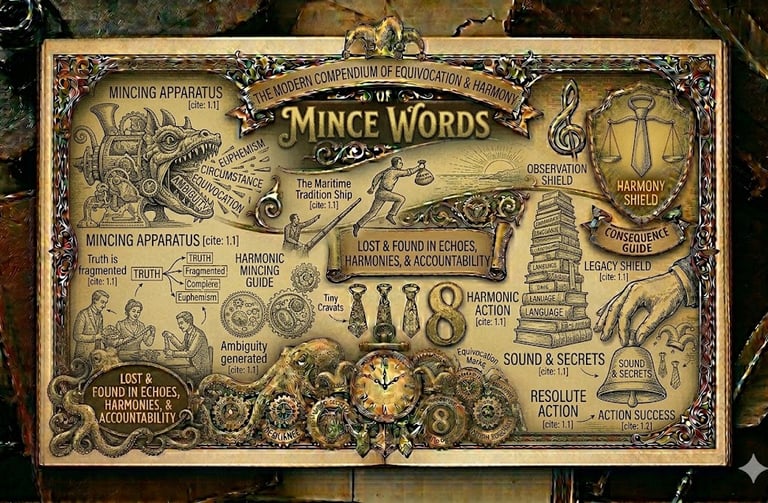
To "mince words" is to speak vaguely or indirectly, often to avoid causing offense or to soften a harsh truth. Conversely, the more common negative form, "not to mince words," means to speak bluntly and directly, regardless of how the listener might feel.
The Deep Dive
The phrase is a culinary metaphor that has been part of the English language for over four centuries, evolving from the kitchen to the boardroom.
Culinary Precision: The verb "mince" comes from the Old French mincier, meaning to chop into very small pieces. In a 14th-century kitchen, mincing made tough meat easier to swallow and digest. When applied to speech in the 1500's, "mincing" your words meant breaking a harsh statement into smaller, more "palatable" pieces so the listener wouldn't find the truth too difficult to stomach.
The Shakespearean Standard: William Shakespeare was a frequent user of the term to denote affected or softened speech. In Henry V, King Henry tells Katherine, "I know no ways to mince it in love, but directly to say 'I love you.'" He was emphasizing that he wasn't going to use flowery, indirect language; he was going to give it to her straight.
Minced Oaths: A related concept is the "minced oath," where a swear word is altered to make it less offensive—such as saying "gosh" instead of "God" or "darn" instead of "damn." This is the literal mincing of a word to strip it of its perceived "poison," allowing the speaker to express frustration without violating social or religious taboos.
Fast Facts
The "Affected" Walk: In the 16th century, "mincing" also described a way of walking with short, dainty steps. This reinforced the idea of the word as something "affected" or insincere, contrasting with a bold, direct "straight arrow" stride.
Disraeli’s Bluntness: One of the earliest recorded uses of the full phrase "not mince my words" appears in Benjamin Disraeli’s 1826 novel Vivian Grey, where a character uses it to introduce a particularly harsh political truth.
References
Shakespeare, W. (1599). Henry V.
Ammer, C. (2013). The Dictionary of Clichés. Skyhorse Publishing.
Oxford English Dictionary. (2026). The Culinary Roots of Metaphorical Language.