Minced Oaths
The Definition
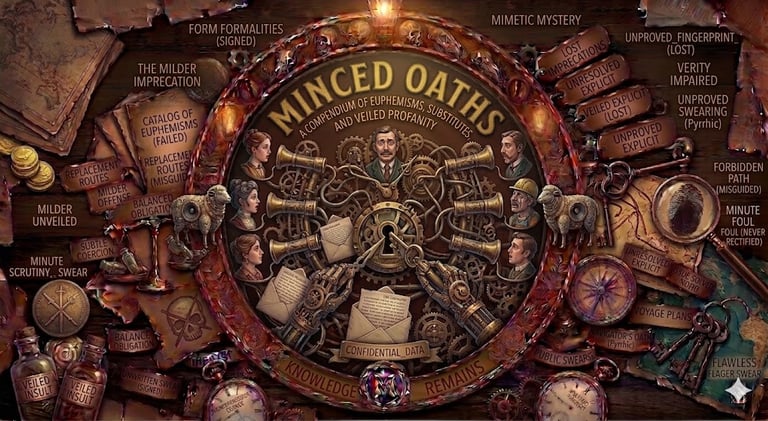
A minced oath is a linguistic euphemism created by deliberately altering, misspelling, or mispronouncing a sacred, blasphemous, or profane phrase. By shifting the phonetics of a forbidden word, the speaker can express intense emotion—such as anger, shock, or frustration—without technically violating religious taboos, breaking social etiquette, or uttering actual profanity.
The Deep Dive
The history of minced oaths is a masterclass in human cleverness, showing how societies create linguistic loopholes to bypass their own strictest moral and legal boundaries.
The Weight of the Medieval Vow: In medieval and early modern Europe, taking the Lord's name in vain or swearing a false oath was not seen as a minor lapse in manners; it was considered a severe spiritual crime and, in many jurisdictions, a legal offense. People genuinely believed that swearing by a deity's body parts physically tore or injured the divine in heaven.
The "Mincing" Solution: Despite the terrifying spiritual stakes, humans still needed a way to vent sudden anger—such as hitting their thumb with a hammer. To solve this, speakers began "mincing" their words (cutting, altering, or softening the harsh syllables). By changing the consonants or vowels just enough, they created a word that sounded vaguely similar to the original oath but carried no theological weight.
The Elizabethan Loophole: The practice exploded in England during the reign of King James I. In 1606, the British Parliament passed the Act to Restrain Abuses of Players. This law imposed a massive £10 fine (an astronomical sum at the time) on any stage actor who in jest or profanely used the holy name of God in a play. Playwrights like William Shakespeare and Ben Jonson immediately began inserting minced oaths into their scripts, allowing their characters to sound authentic and heated on stage without bankrupting the theater company.
The Structural Evolution: Most common minced oaths follow a few predictable phonetic patterns:
Consonant Dropping: Merging syllables into a nonsense word (e.g., Gadzooks instead of "By God's hooks," referring to the nails of the crucifixion).
Rhyming Substitutions: Swapping a sacred name for a common, harmless noun (e.g., Gosh or Golly for God; Darn or Dang for damn).
The "Zounds" Shift: Compressing an entire descriptive phrase into a sharp, single-syllable exclamation (e.g., Zounds instead of "God's wounds").
Fast Facts
"Jeepers Creepers": This classic 20th-century American exclamation is a meticulously minced version of the name Jesus Christ, designed to keep the speaker's language clean while still delivering a sharp, rhythmic burst of surprise.
The "Dad-Blamed" Frontier: The American West generated an entire sub-genre of colorful minced oaths, such as dad-gummed, sam-hill (for Hell), and tarnation (a complex blending of "damnations" and "eternal damnation").
References
Hughes, G. (2006). An Encyclopedia of Swearing: The Social History of Oaths, Profanity, Foul Language, and Ethnic Slurs in the English-Speaking World. M.E. Sharpe.
Ammer, C. (2013). The Dictionary of Clichés. Skyhorse Publishing.
Oxford English Dictionary. (2026). Phonetic Distortion, Legal Censorship, and the Evolution of Euphemistic Exclamations.