Mind Our P’s and Q’s
The Definition
To be on one’s best behavior; to be careful of one’s speech and manners. It is an instruction to pay attention to the small details of etiquette and social propriety.
The Deep Dive
This phrase is a "triple-threat" of junk knowledge, with three competing—and equally plausible—origin stories. While we use it today as a general nudge toward politeness, its roots are likely found in the messy workspaces of the 17th century.
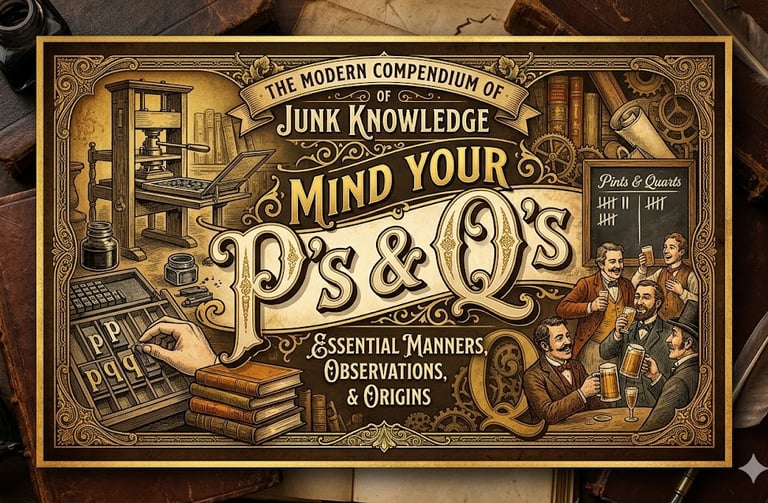
The Typesetter’s Trap: The most widely accepted origin comes from the world of movable type printing. In a traditional print shop, letters were cast in reverse on small metal blocks. To a young apprentice (a "printer's devil"), the lowercase p and q were mirror images of each other. If you weren't careful when "setting the type," you would accidentally swap them, ruining an entire page of text. "Mind your p’s and q’s" was a literal warning to pay attention to the direction of the descenders.
The Pubhouse Tally: Another popular theory places the phrase in the local tavern. Publicans (innkeepers) would keep a running tab for regular customers on a chalkboard behind the bar. They would mark the number of Pints and Quarts consumed. If a patron didn't "mind their P's and Q's," they might find themselves with a bill they couldn't pay—or a level of intoxication that led to a night in the stocks.
The French Courtly Bow: A more refined theory suggests it originated in the 18th-century French court. Dancing masters would warn their pupils to "mind your pieds (feet) and queues (wigs)." When performing a deep bow, a dancer had to be careful not to step on their own feet or have their elaborate powdered wig fall off.
Regardless of which version you believe, the phrase shifted from a technical warning into a general idiom for "becoming mindful" by the late 1700's. It was famously used in the 1779 play Who’s the Dupe? by Hannah Cowley, where a character is told to "mind your P's and Q's" to avoid social embarrassment.
Fast Facts
The "Pee" and "Kue" Link: Some linguists argue it’s simply a shorthand for "Mind your Pleas and Thank-yoQs," though this is often dismissed as a modern "backronym."
The Sailors’ "Queues": In the British Navy, sailors wore their hair in long, tarred pigtails called "queues." They were warned to mind their "P's" (peas—the standard ration) and their "Q's" (queues—keeping their hair neat for inspection).
The "P" and "Q" Alphabet: In logic and mathematics, "p and "q" are the standard variables used for propositions, though this has no known link to the etiquette of the idiom.
References
Cowley, H. (1779). Who’s the Dupe?. (Act I, Scene 1).
Moxon, J. (1683). Mechanick Exercises: Or, the Doctrine of Handy-works. (On the art of printing).
Ammer, C. (2013). The Dictionary of Clichés. Skyhorse Publishing.
The Oxford English Dictionary. (2026). P (n.) and Q (n.). Oxford University Press.