Money for Old Rope
The Definition
A way of describing money that is earned very easily, often for little to no effort. It suggests a profit made from something that others might consider worthless or a task that requires zero skill.
The Deep Dive
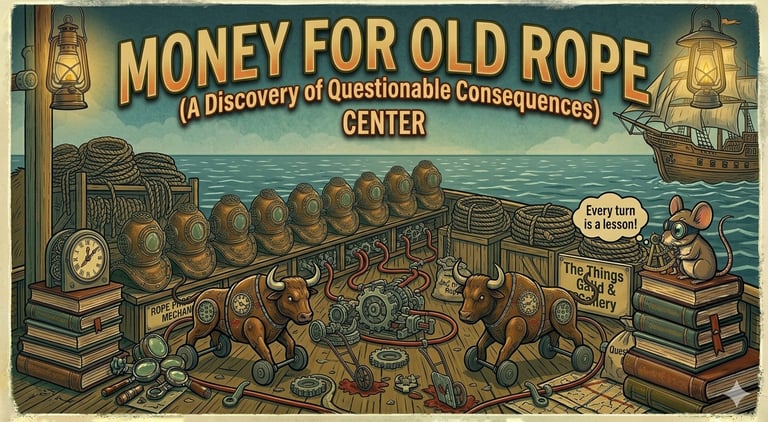
The phrase is deeply rooted in the maritime economy of the 18th and 19th centuries. In the days of the Great Age of Sail, ships required miles of hemp rope to function. However, the salt air, constant tension, and friction eventually wore the fibers down, making the rope unsafe for rigging.
Instead of throwing this "junk" away, sailors and dockworkers found a secondary market for it. This led to two primary ways to get "money for old rope":
The Oakum Trade: Old, frayed ropes were picked apart into raw fibers called oakum. This loose fiber was then mixed with pine tar and hammered into the seams of wooden ships to make them watertight (caulking). Selling the old rope to "oakum pickers"—often prisoners or the destitute—was a guaranteed, albeit small, source of income for the ship’s crew.
The Paper Mill: Old hemp rope was also highly sought after by paper mills. Before wood pulp became the standard, high-quality paper was made from linen and hemp rags. Selling discarded ship’s rope to these mills was seen as "free money" because the resource was essentially industrial waste.
The transition to its modern meaning—meaning "easy money"—gained momentum in the early 20th century. If you could sell a literal piece of trash (old rope) and get paid for it, you had mastered the art of the easy buck.
Fast Facts
The Labor: While selling the rope was easy, picking the rope into oakum was notoriously brutal work, often used as a punishment in Victorian workhouses and prisons.
The Yield: A single 74-gun ship of the line could carry over 30 miles of rope, providing a massive supply of "old rope" for the local economy whenever the rigging was replaced.
The Quality: Rope-based paper was so durable that it was often used for legal documents and banknotes, meaning "money for old rope" sometimes literally became money.
References
Constable, G. (2009). The Inexorable Rise of the Workhouse. Pen and Sword Books.
King, D. (2000). A Sea of Words: A Lexicon and Companion to the Patrick O'Brian Novels. Henry Holt & Co.
Mayhew, H. (1851). London Labour and the London Poor. George Woodfall and Son.
Rogers, J. (1985). The Dictionary of Clichés. Facts on File Publications.