Monkey Business
The Definition
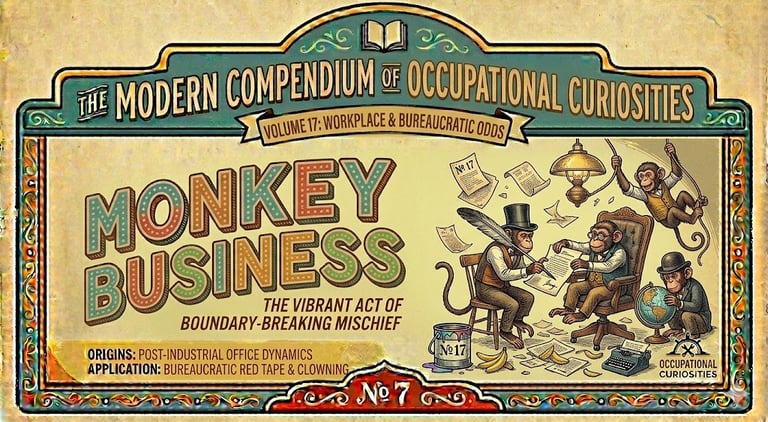
This idiom refers to mischievous, deceitful, or unprofessional behavior. It often implies a level of trickery or "junk" activity that is meant to undermine a process or avoid serious work. While it can describe harmless pranking, it is frequently used to call out unethical conduct in business or politics.
The Deep Dive
The phrase emerged in the mid-19th century, drawing on centuries of human observation regarding the unpredictable and often frustrating nature of primates.
The Primate Proxy: Monkeys have long been viewed in Western culture as caricatures of humans—capable of mimicking our actions but lacking our moral restraint or seriousness. By the 1840's, the term "monkey" was being used as a verb to mean "to trifle" or "to fool around." "Monkey business" became the formalized noun for this type of unproductive or deceptive meddling.
The "Tricky" Evolution: In the early 20th century, the phrase took on a sharper edge. It moved away from simple "messing around" and began to describe clandestine or illicit activities. If a ledger didn't balance or a political deal seemed suspicious, it was dismissed as "monkey business." It suggested that someone was acting "outside the lines" of fair play, using cleverness to hide their tracks.
Cinematic Slapstick: The 1931 Marx Brothers film Monkey Business cemented the term in the American lexicon. The film’s chaotic, anti-authoritarian energy perfectly captured the "hot mess" aspect of the idiom—where authority is mocked and the rules are treated as mere suggestions.
Fast Facts
The "Monkeying Around" Connection: This related verb form is generally more innocent, referring to harmless play or curiosity, whereas "monkey business" carries a stronger whiff of intentional deception.
Aviation Link: In World War II, pilots sometimes used the term to describe mechanical "gremlins" or inexplicable glitches in their aircraft—the literal "wrench in the works" that felt like the work of a mischievous animal.
References
Ammer, C. (2013). The Dictionary of Clichés. Skyhorse Publishing.
Lighter, J. E. (1994). Historical Dictionary of American Slang.
Oxford English Dictionary. (2026). Anthropomorphism in 19th-Century Colloquialisms.