Mystery Meat
The Definition
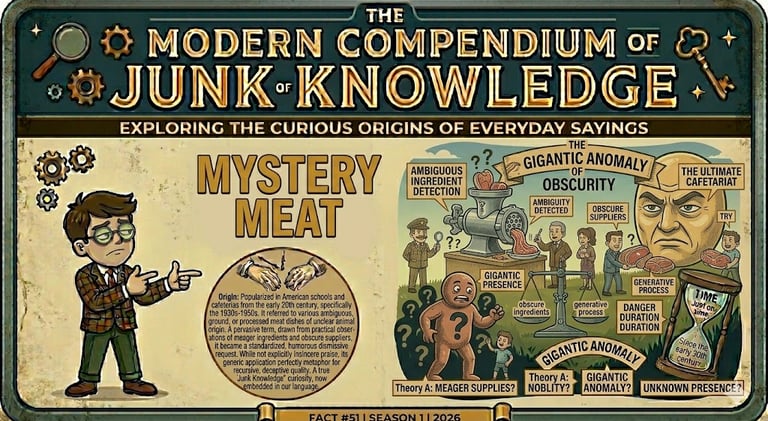
"Mystery meat" is a derogatory slang term for highly processed, unidentifiable meat products served in institutional settings like public school cafeterias, military mess halls, and prisons. Characterized by a uniform, ambiguous texture, lack of recognizable grain, and heavy reliance on thick gravies or sauces to mask its flavor, the term has grown metaphorically to describe any product, technology, or situation whose true components, quality, or origins are completely hidden from the end user.
The Deep Dive
The term captures a mid-20th-century intersection of industrial food science, government surplus distribution, and the collective trauma of institutional dining.
The Industrialization of Scrap: The physical reality of mystery meat was born out of the efficiency demands of post-WWII industrial food processing. Mechanically separated meat (MSM) technologies allowed processing plants to use high-pressure machinery to strip the absolute last remnants of edible tissue from animal carcasses. The resulting paste was then bound together with starches, sodium, and preservatives, molded into uniform shapes (like patties or loaves), and frozen for mass shipment.
The Institutional Pipeline: In the United States, the phrase became universally cemented in the public consciousness through the National School Lunch Program, established in 1946. To keep costs low, the federal government purchased massive surpluses of agricultural commodities and distributed them to public schools. Because these bulk meat shipments arrived pre-ground, precooked, and vacuum-sealed in generic institutional packaging, the students eating them literally could not tell if they were consuming beef, pork, turkey, or a combination of all three.
The Culinary Disguise: The defining characteristic of a mystery meat dish is the presence of an aggressive camouflage layer. Because mass-processed meat lacks natural moisture and can develop an unappealing gray hue, institutions traditionally drench it in heavy brown gravy, highly sweetened tomato sauces (such as sloppy joe mix), or thick processed cheeses. This hiding of the core ingredient birthed the universal schoolyard joke that the lunch lady was serving "mystery meat."
The Digital Leap (Mystery Meat Navigation): In 1998, renowned web design author Vincent Flanders took the phrase out of the cafeteria and dropped it directly into the tech world. He coined the term "Mystery Meat Navigation" (MMN) to describe web interfaces where the destinations of buttons or links are completely invisible until the user hovers over them or clicks them blind. Just like the cafeteria food, the user has to guess what they are getting, representing a massive failure in user experience design.
Fast Facts
The Spam Distinction: While often lumped into the same category, brand-name products like SPAM are technically not mystery meat. SPAM has a strictly documented, legally transparent ingredient list (primarily pork shoulder and ham), whereas true mystery meat deliberately obscures its exact animal percentages behind institutional phrasing like "meat food product."
The "Pink Slime" Panic: In the early 2010’s, the mystery meat discourse re-entered the national news cycle with the controversy over "lean finely textured beef" (LFTB), dubbed "pink slime" by the media. The public backlash highlighted a deep-seated cultural anxiety about losing sight of the natural origins of the food we consume.
References
Flanders, V. & Willis, M. (1998). Web Pages That Suck: Learn Good Design by Looking at Bad Design. Sybex Inc.
Levenstein, H. (2003). Paradox of Plenty: A Social History of Eating in Modern America. University of California Press.
Oxford English Dictionary. (2026). The Lexicon of Mid-Century Institutional Slang and Culinary Euphemisms.