Namby Pamby
The Definition
Lacking in character, substance, or courage; weak, indecisive, or overly sentimental. It describes something that is "wishy-washy" or "milk-and-water"—often used to mock art or behavior that feels childishly precious.
The Deep Dive
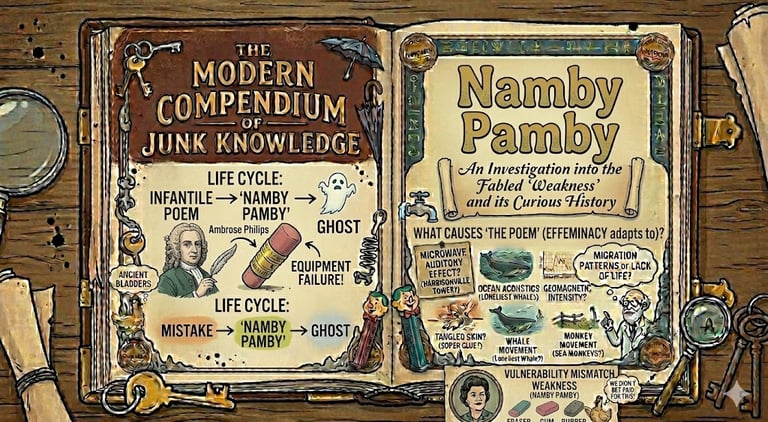
This is born from one of the most vicious literary feuds in history. In the early 18th century, the London poetry scene was a battlefield, and the primary casualty was a poet named Ambrose Philips.
The "Infantile" Offense: Philips had a habit of writing cloyingly sweet, simplistic odes to the infant children of his wealthy Whig patrons. His verses used a distinctive, short-lined "sing-song" rhythm that his rivals found nauseatingly sycophantic. Sample lines included: "Timely blossom, Infant fair / Fondling of a happy pair."
The "Namby" Nickname: In 1725, the poet and dramatist Henry Carey—a friend of the great satirist Alexander Pope—penned a devastating parody titled Namby Pamby: or, a Panegyrick on the New Versification.
"Namby" was a mocking, nursery-style play on "Ambrose".
"Pamby" provided the reduplicative rhyme that made it sound like baby talk.
The Scriblerus Pile-On: The nickname was so catchy that the heavy hitters of the era, including Alexander Pope and Jonathan Swift, gleefully adopted it. Pope even included it in his masterpiece of mockery, The Dunciad, permanently cementing "Namby Pamby" as a label for anyone whose wit was "little" and whose courage was "weak."
Poor Ambrose Philips was so enraged by the "Namby" label that he reportedly kept a birch rod hanging at Button’s Coffee House, threatening to whip Alexander Pope if he ever showed his face there. Pope, who was small and physically frail, wisely avoided the coffee house, but the nickname outlived both men by centuries.
Fast Facts
The "Sell-Out" Stigma: The sting of the nickname wasn't just about the bad poetry; it was a political accusation. His rivals believed Philips was "selling his soul" to the Whig establishment by writing "nursery rhymes" to their children in exchange for government jobs.
The "Andy Pandy" Connection: Some linguists suggest that the 1950's British children's character Andy Pandy was a soft, kind-hearted nod to the rhythmic structure of the original "Namby Pamby" mockery.
The First Print: While the poem was written in 1725, the term was being used as a general adjective for "weak or effeminate" by 1745.
References
Carey, H. (1725). Namby Pamby: or, a Panegyrick on the New Versification.
Pope, A. (1728). The Dunciad.
Johnson, S. (1781). Lives of the Most Eminent English Poets. (Entry on Ambrose Philips).
The Oxford English Dictionary. (2026). Namby-pamby (adj. and n.). Oxford University Press.