Neon Sign
The Definition
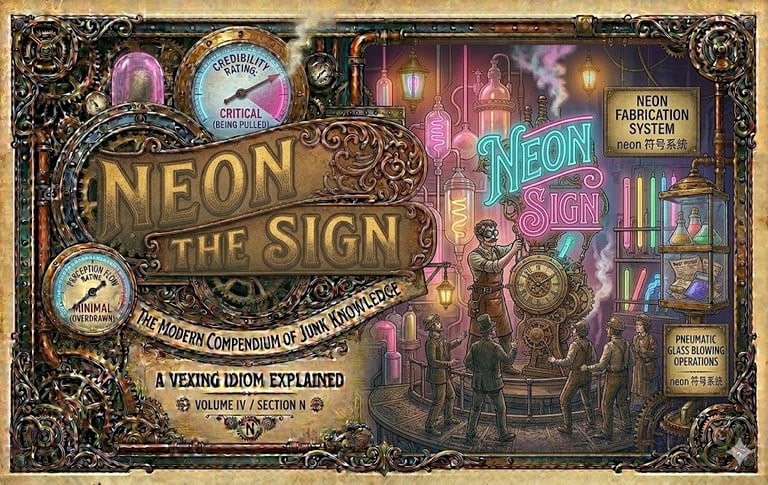
A neon sign is a luminous-tube light that contains rarefied neon or other gases. When a high voltage is applied to electrodes at the ends of the tube, the gas ionizes and emits a distinctive glow. While the term "neon" is used generically for all such signs, it is a proprietary eponym for a family of "noble" gases that produce different colors when electrified.
The Deep Dive
The neon sign is a product of 19th-century vacuum experimentation that eventually became the "visual heartbeat" of the modern city.
The Scientific "Junk" Discovery: In 1898, British chemists Sir William Ramsay and Morris Travers discovered neon by chilling a sample of atmosphere until it became a liquid, then warming the liquid and capturing the gases as they boiled off. When they applied a discharge to the new gas, Ramsay described the "blaze of crimson light" as a sight he would never forget.
The Liquid Air Pivot: In 1910, French engineer Georges Claude (the father of the neon sign) was looking for a way to use the neon gas that was being produced as a byproduct of his air-liquefaction business. He realized that sealing the gas in glass tubes and applying a current created a brilliant, long-lasting light source that far outshone the incandescent bulbs of the time.
The "Liquid Fire" of Advertising: Claude debuted his invention at the Paris Motor Show in 1910. By 1923, he brought the technology to America, selling two signs to a Packard car dealership in Los Angeles for $24,000. People were so captivated by the unblinking, vivid red light that they would stand in the street just to stare at it, calling it "liquid fire."
The Gas Palette: To create different colors, sign makers use different gases and tinted glass. Pure Neon creates the iconic red. Argon mixed with a drop of mercury creates a vibrant blue. Helium produces gold, and Krypton creates a silvery-white. By coating the inside of the tubes with phosphors—the same science used in old television screens—thousands of color variations can be achieved.
Fast Facts
The "Nightlife" Symbol: Neon became synonymous with the mid-century aesthetic of diners, motels, and Vegas strips. Its decline in the 1970's was due to the rise of cheaper, more durable plastic and LED signs, but it has recently seen a resurgence as a retro art form.
Whispering Light: If you stand near a large neon sign, you can often hear a distinct "hum." This isn't the gas; it's the vibration of the heavy-duty transformers required to step up the voltage to ionize the gas inside the tubes.
References
Claude, G. (1913). L'Électricité et ses applications.
Ammer, C. (2013). The Dictionary of Clichés. Skyhorse Publishing.
Oxford English Dictionary. (2026). The Noble Gases and the Architecture of 20th-Century Commercialism.