No Funny Business
The Definition
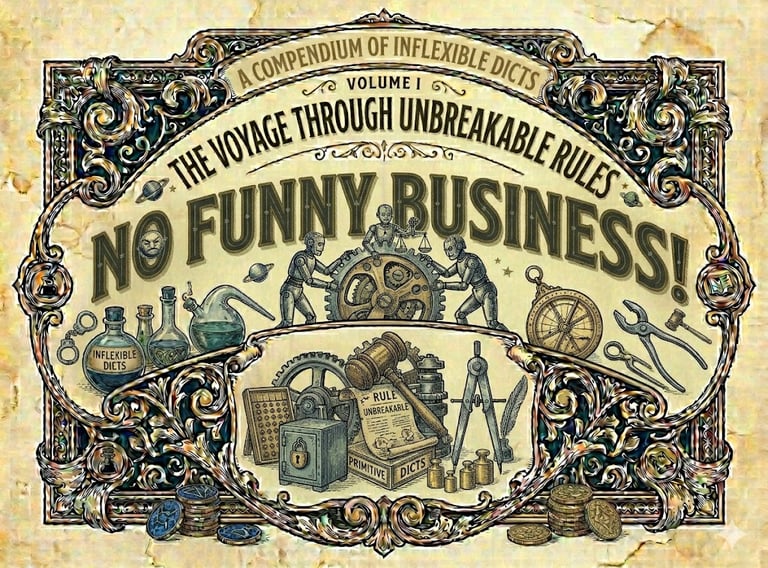
"No funny business" is an authoritative command or warning issued to prevent underhanded trickery, cheating, unauthorized tinkering, or suspicious behavior. While it sounds lighthearted on the surface, it functions as a strict baseline boundary—notifying the listener that they are under close surveillance and that any deviation from the established rules will result in immediate consequences.
The Deep Dive
The phrase is a direct, mid-20th-century evolution of the older idiom "monkey business," but it carries a sharper, more urgent tone of personal accountability.
The Evolution of "Funny": In the English language, the word "funny" has always possessed a dual identity. It can mean humorous (something that provokes laughter), but it also means strange, irregular, or highly suspicious (as in "I hear a funny noise in the engine" or "There's something funny about these financial records"). The phrase "no funny business" completely discards the humorous definition and weaponizes the suspicious one.
The Post-War Authority: The phrase exploded into mainstream American speech during the 1940’s and 50’s. It became the signature vernacular of film-noir detectives, factory foremen, and school principals. Unlike "monkey business," which often implies a chaotic, playful messing around behind someone's back, "funny business" implies a calculated, deliberate attempt to deceive or cheat.
The Premptive Strike: When an authority figure issues the command "And no funny business," they are executing a preemptive behavioral boundary. They are acknowledging that a temptation to cheat, cut corners, or break a protocol exists, and they are declaring that the standard defensive excuses ("I didn't know," "It was an accident") have already been factored in and rejected.
Contextual Applications
The beauty of the phrase lies in its immense flexibility across entirely different arenas of life:
The Contractor and the Blueprint: In manual trades and construction, a project manager might tell an independent contractor, "I want this framework built exactly to code—no funny business with the materials." Here, it means no substituting cheaper, unvarnished lumber or skipping structural fasteners to pad the profit margin.
The Digital Domain: In modern cybersecurity and software development, the phrase has been translated into technical protocols. Engineers design systems to detect "funny business" in data streams—such as a sudden, erratic spike in automated server requests or unauthorized attempts to alter code lines, triggering immediate security lockouts.
The Domestic Baseline: At home, it remains the ultimate parting phrase for parents leaving teenagers home alone for the weekend, summarizing an entire textbook of household rules into a single, unyielding four-word guardrail.
Fast Facts
The "Straight Arrow" Antonym: The direct character antonym to someone engaging in funny business is a "straight arrow"—an individual whose conduct, business dealings, and personal ethics are completely transparent, predictable, and aligned with the rules.
The Cinematic Trope: The phrase became an essential staple of mid-century Hollywood gangster and heist movies. It was almost always delivered by a criminal boss or a bank guard right before a high-stakes exchange, serving as a linguistic cue to the audience that a major double-cross was about to unfold.
References
Mencken, H. L. (1948). The American Language: Supplement II. Alfred A. Knopf. (Tracking the hardening of Gilded Age slang into post-war authoritative idioms).
Ammer, C. (2013). The Dictionary of Clichés. Skyhorse Publishing.
Oxford English Dictionary. (2026). The Semantic Dualism of "Funny" and the Codification of Mid-Century Behavioral Mandates.