Nose Out of Joint
The Definition
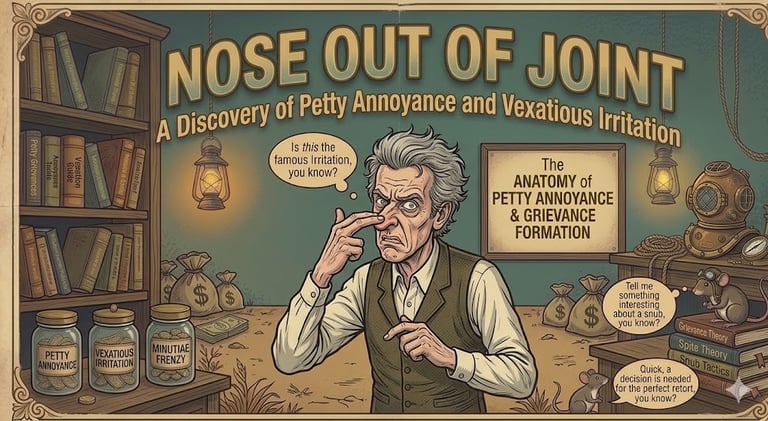
To have your "nose out of joint" means to be deeply offended, resentful, hurt, or filled with sudden jealousy—typically because you have been slighted, passed over for an honor, or displaced from a position of prime importance by someone else. It describes a state of visible, petulant irritation where an individual’s pride or ego has suffered a sharp, humbling blow.
The Deep Dive
While modern speakers might assume this phrase is a piece of 20th-century cartoon vernacular, it is actually a remarkably ancient anatomical metaphor that has been circulating in the English language for nearly five hundred years.
The Visual Metaphor of Distortion: Physically speaking, a dislocated joint (like a shoulder or a knee) is deeply painful, functionally useless, and visually grotesque. Because the nose sits at the absolute center of the human face, it serves as the literal focal point of personal identity and expression. To say someone's nose has been put "out of joint" implies that a sudden emotional blow has completely shattered their composed, attractive public face, leaving their expression twisted into a ugly, unmistakable scowl of wounded pride.
The Elizabethan Stamp: The phrase was already firmly established as standard everyday slang during the English Renaissance. The earliest recorded use appears in 1581 in a translation of Erasmus's Apophthegmes. It quickly became a favorite linguistic tool for Elizabethan playwrights to describe courtly jealousy. In 1662, the famous London diarist Samuel Pepys used it to describe palace intrigue, noting that a government official was thoroughly enraged because a rival had bypassed his authority: "The King is pleased... which will put Sir John Lawson's nose quite out of joint."
The Displacement Dynamic: Historically, the phrase carried a highly specific domestic meaning regarding childbirth and family dynamics. For centuries, when a toddler became suddenly hostile, clingy, or prone to tantrums following the birth of a new baby sibling, parents would say the older child had their "nose put out of joint." The new infant had instantly usurped the toddler's position as the absolute center of attention and affection, forcing the older child to confront their very first taste of social displacement.
The Ego Squeeze: In modern organizational psychology and workplace dynamics, having one's nose out of joint is viewed as a natural, albeit unprofessional, reaction to a loss of status. When a corporate restructuring reassigns a long-term manager's favorite project to a newcomer, or when an independent contractor's advice is bypassed in favor of a new strategy, the resulting friction is rarely about the work itself—it is the unvarnished sound of an ego adjusting to being shoved out of the spotlight.
Fast Facts
The "Cut Off Your Nose" Cousin: The phrase is a close psychological relative to "cutting off your nose to spite your face," another ancient nasal idiom that describes a self-destructive outburst where an individual damages their own interests out of pure, unyielding resentment.
The Animal Inversion: While humans get their noses put out of joint when they lose status, dogs display a remarkably similar behavioral pattern known as canine cognitive jealousy, frequently acting out or wedging themselves physically between their owners and a new pet or object to reclaim their territory.
References
Erasmus, D. (1581 edition). Apophthegmes (Translated by Nicolas Udall).
Pepys, S. (1662). The Diary of Samuel Pepys. entries on naval administration and court politics.
Oxford English Dictionary. (2026). The Early Modern Codification of Anatomical Metaphors and Domestic Idioms.