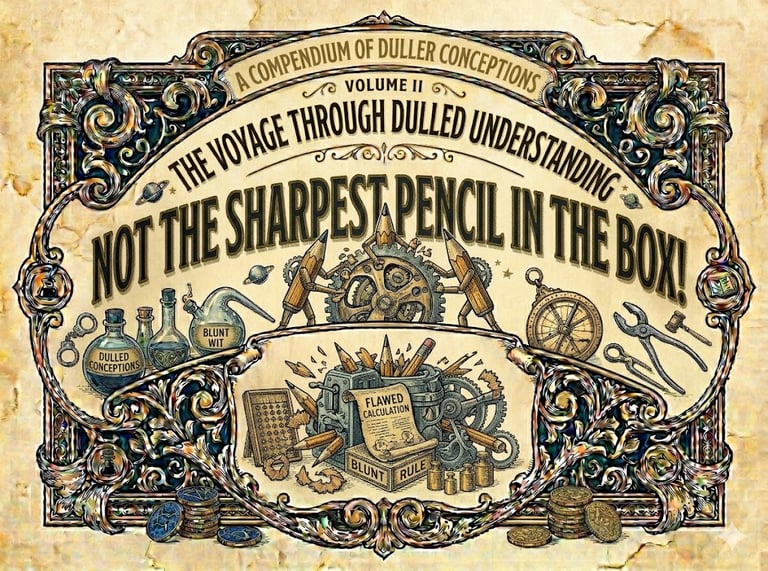
Not the Sharpest Pencil in the Box
The Definition
To describe someone as "not the sharpest pencil in the box" is a humorous, polite, yet deeply cutting euphemism for stating that a person lacks intelligence, mental agility, or basic common sense. It belongs to a vast family of idioms designed to soften the blow of a direct insult by framing it as a comparative measurement of a common household object.
The Deep Dive
The phrase is a product of late-20th-century workplace and schoolyard vernacular, emerging from the mass-production of office supplies and the universal experience of standardized testing.
The Metaphor of the Edge: Historically, human cultures have always linked mental capability to sharpness. A highly intelligent person is described as sharp, acute, or possessing a keen mind—all adjectives borrowed directly from the physical edge of a blade or a knife. To have a sharp mind means you can easily cut through a dense, complex problem to find the unvarnished solution.
The Utilitarian Shift: By the mid-1900’s, as society shifted from agrarian life to massive corporate offices and industrialized school systems, the knife metaphor was swapped out for a more domestic, academic tool: the standard graphite pencil. A fresh box of No. 2 pencils represents potential, readiness, and precision.
The Dull Trajectory: Conversely, a pencil that is dull or has its lead broken requires more effort to use, produces thick, smudged, messy lines, and is functionally useless for precision work until it is repaired. By describing a person as not the sharpest pencil, the speaker isn't saying the individual is completely useless or broken—they are simply noting that when it comes to quick, precise cognitive tasks, this specific tool is running with a distinctly blunt edge.
The "Ironic Complement" Structure: Linguistically, the phrase relies on a rhetorical device known as litotes—affirming a characteristic by denying its opposite. Instead of aggressively calling someone "stupid" or "incompetent," which creates instant social hostility, the speaker frames it as a mild, observation-based comparison. This allows the insult to bypass standard social filters, often provoking a laugh from onlookers while still delivering a devastating assessment of the subject's capabilities.
Fast Facts
The "One-Line" Weapon: In modern political campaigning and corporate boardroom banter, these phrases are treated as premier rhetorical weapons. They allow a speaker to completely dismantle an opponent's argument on a debate stage or in a meeting without technically violating institutional rules against explicit profanity or vulgar personal attacks.
The Mechanical Irony: In modern design circles, the classic wooden pencil has largely been replaced by mechanical pencils that never need sharpening. Despite this technological shift, the idiom remains heavily anchored in the language, showcasing how deeply our idioms rely on the nostalgic physical objects of childhood.
References
Ammer, C. (2013). The Dictionary of Clichés. Skyhorse Publishing.
Green, J. (2010). Green's Dictionary of Slang. Chambers Harrap.
Oxford English Dictionary. (2026). The Proliferation of Industrial Supply Metaphors and Euphemistic Incompetence Idioms.