Not Worth a Continental
The Definition
Completely and utterly worthless; having no practical or monetary value. It describes a thing or an idea that has been so devalued by circumstance that it isn't even worth the paper it’s printed on.
The Deep Dive
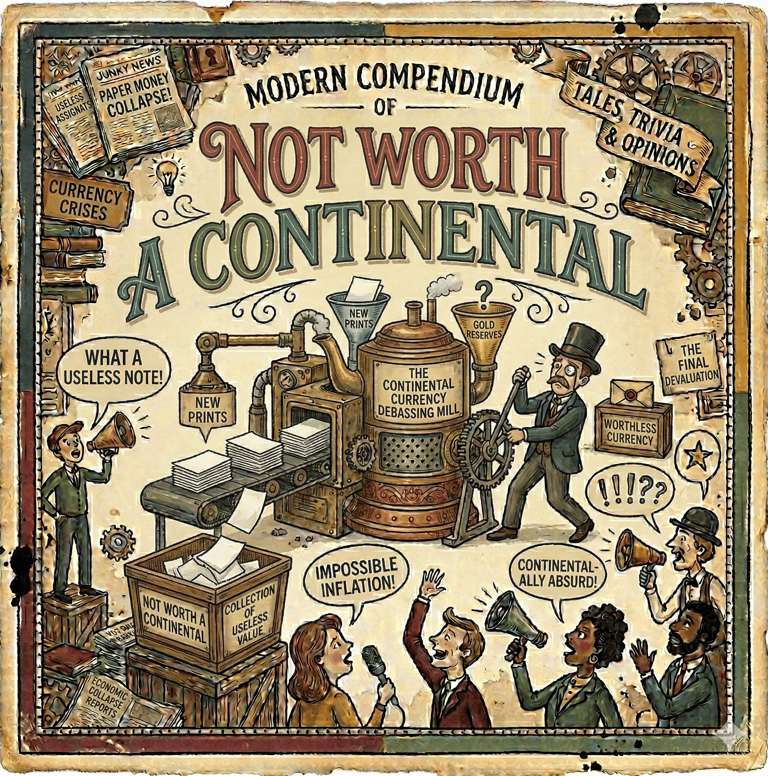
This is a literal piece of "junk knowledge" from the birth of the United States. In 1775, the Continental Congress needed a way to fund the Revolutionary War against Great Britain. Since they had no power to tax and very little gold or silver, they did the only thing they could: they printed money.
The "Continental" Currency: These early paper bills were called "Continentals." They weren't backed by physical gold; they were backed only by a "promise" that they would be redeemed for Spanish milled dollars once the colonies won the war.
The Printing Press Trap: As the war dragged on, the Congress printed more and more. In 1775, there were $6 million in circulation; by 1779, there were over $240 million.
The British Sabotage: To make matters worse, the British began a massive counterfeiting operation. They flooded the colonies with high-quality fake Continentals to crash the American economy.
The Result: By 1781, the currency had collapsed so spectacularly that it took $1,000 in paper to buy what $1 in gold once could. Merchants refused to take it, and sailors famously used the bills to wallpaper their cabins or made "suits" out of them as a joke.
The phrase "not worth a continental" became the defining insult of the late 18th century. It was a stinging reminder of a government that had "spent" its credibility before it had even fully formed. Even after the U.S. Constitution was ratified and a new, stable currency was established, the idiom survived as a linguistic ghost of the country's first financial disaster.
Fast Facts
The "Penny" Connection: This is the 18th-century ancestor of the 20th-century phrase "not worth a plug nickel" or "not worth a red cent."
The Barber's Jest: In Philadelphia, a popular joke involved a barber who covered his walls with Continental bills and offered a "free shave for a handful of money," knowing the paper was worth less than the soap he used.
The First Print: While the sentiment was common during the war, the exact phrase appeared in American newspapers by the 1780's, often used by angry veterans who had been paid for their service in the worthless paper.
References
Wright, R. E. (2008). One Nation Under Debt: Hamilton, Jefferson, and the History of What We Owe. McGraw-Hill.
Bolles, A. S. (1879). The Financial History of the United States, from 1774 to 1789.
Ammer, C. (2013). The Dictionary of Clichés. Skyhorse Publishing.
The Oxford English Dictionary. (2026). Continental (adj. and n.). Oxford University Press.