Off the Record
The Definition
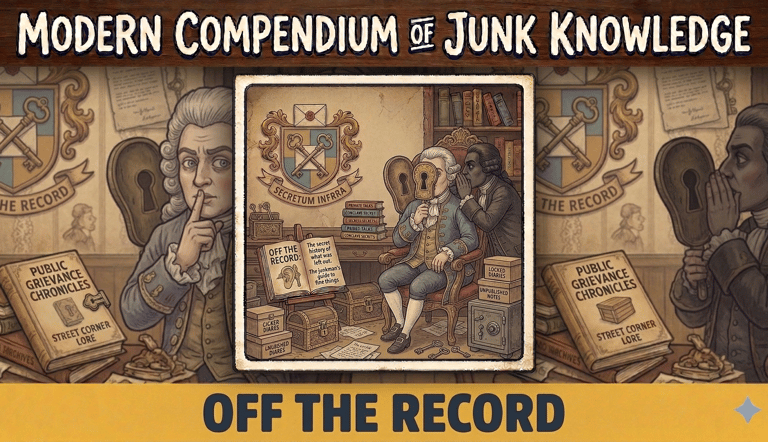
Information provided to a journalist or an official that is not meant to be published, broadcast, or attributed to the source. It describes a "protected" conversation where the speaker can be candid without the fear of their words appearing in the morning headlines.
The Deep Dive
This is a literal piece of "junk knowledge" from the high-stakes evolution of the White House Press Corps. While the concept of a "private chat" is as old as gossip, the formal, mechanical "rules" of the "record" were forged during the presidency of Franklin D. Roosevelt.
The FDR Innovation: Before FDR, presidential press conferences were stiff, formal, and often required questions to be submitted in writing days in advance. In 1933, Roosevelt changed the game by inviting reporters into the Oval Office for twice-weekly, informal "talks."
The Four Categories: To manage the flow of information without causing diplomatic incidents, FDR established a system of "record-keeping" that reporters had to follow:
On the Record: Direct quotes could be used.
Background: The info could be used, but the source must be vague (e.g., "a high-ranking official").
Deep Background: The info could be used, but no source could be mentioned at all.
Off the Record: The information was for the reporter's personal understanding only—it could not be used in any form.
The Stenographer’s Pen: The "record" was the official transcript kept by the White House stenographer. When FDR said, "This is off the record," the stenographer would physically lift their pen from the paper or draw a line through the notes.
The phrase moved from the Oval Office to the general public by the late 1940's. It became a staple of "Noir" detective films and political thrillers, where a character would lean in and whisper, "Now, this is off the record..." to signal the start of a dangerous truth.
Fast Facts
The "Deep Throat" Connection: This is the spiritual ancestor of the 1970's Watergate term "Deep Background," where the source (Mark Felt) provided the roadmap for the investigation but refused to be "on the record" for decades.
The Professional Risk: In modern journalism, "off the record" is a verbal contract. If a reporter breaks it, they lose their credibility; if a source lies while "off the record," they lose their access.
The "Live Mic" Blunder: Many famous political scandals have occurred when a speaker thought they were "off the record" (or that the mic was off) when it was actually "on," leading to what is known as a "Kinsley gaffe"—accidentally telling the truth.
References
Winfield, B. H. (1990). FDR and the News Media. University of Illinois Press.
Ammer, C. (2013). The Dictionary of Clichés. Skyhorse Publishing.
The Oxford English Dictionary. (2026). Record (n.1). Oxford University Press.
The Associated Press Stylebook. (2026). Guidelines on Attribution.