On the Mark
The Definition
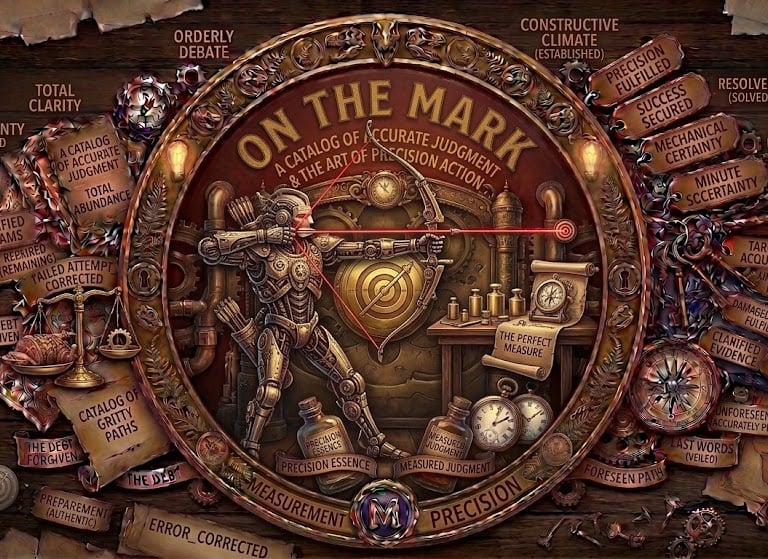
This idiom signifies that something is entirely accurate, correct, or valid. Much like its cousin, "right on the money," it describes a statement, guess, or physical action that hits the exact center of its intended target. It is the hallmark of "straight arrow" precision.
The Deep Dive
The phrase has deep roots in two worlds where precision is the only measure of success: ancient marksmanship and early track-and-field athletics.
The Archer’s Aim: Historically, "the mark" was the literal object being aimed at—whether a target on a tree or a straw butt in an archery contest. A shot that was "on the mark" wasn't just close; it was a bullseye. In the Middle Ages, failure to be on the mark could mean the difference between a successful hunt and going hungry, or winning a competition and losing one's prestige.
The Starting Line: In the 19th century, the phrase took on a second literal meaning with the rise of organized racing. Runners were told to get "on their marks," referring to the starting line scratched into the dirt. To be "on the mark" meant you were perfectly positioned, ready to launch without being "off" or committing a foul. It represented the ideal starting state for any endeavor.
The Cognitive Bullseye: Today, we use it to describe intellectual accuracy. If an analyst predicts a stock's movement perfectly, or a writer captures the exact essence of a character, their insight is "on the mark." It implies that the person hasn't just avoided the "junk" of speculation but has pierced through the noise to find the absolute truth.
Fast Facts
The "Wide of the Mark" Antonym: This refers to the opposite—an arrow that misses the target entirely or a guess that is fundamentally flawed.
Historical Records: The phrase appears in various forms in English literature as far back as the 1600's, often used in both literal sporting contexts and as a metaphor for moral or religious rectitude.
References
Ammer, C. (2013). The Dictionary of Clichés. Skyhorse Publishing.
Ayto, J. (1990). Dictionary of Word Origins. Arcade Publishing.
Oxford English Dictionary. (2026). The Evolution of Marksmanship Terminology in Modern Vernacular.