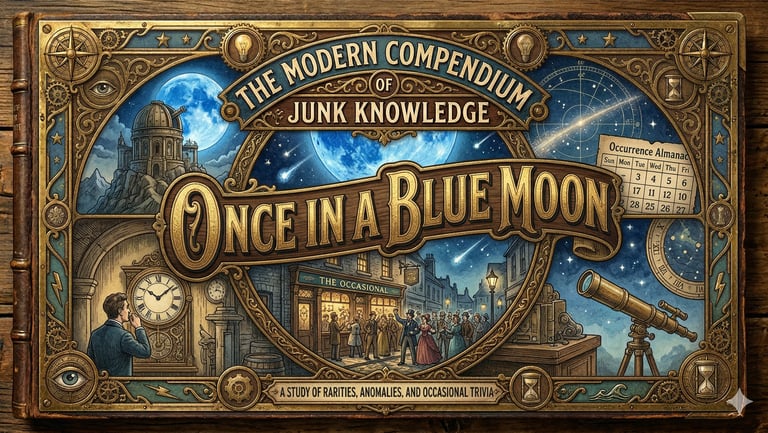
Once in a Blue Moon
The Definition
Very rarely; an event that happens so infrequently that it is considered a mathematical or atmospheric outlier. It describes a situation that is the "exception to the rule."
The Deep Dive
This is a "high-gravity" piece of junk knowledge that pits the rigid math of the Gregorian calendar against the literal "junk" in the atmosphere.
The Calendar Math: A solar year is roughly 365 days, while a lunar month (the time between full moons) is 29.5 days. Because the numbers don't align perfectly, most years have 12 full moons—one for each month. However, every 2.7 years, the "extra" days accumulate, resulting in 13 full moons in a single year.
The "Two-Full-Moons-in-a-Month" Rule: While the Maine Farmers' Almanac originally defined a Blue Moon as the third moon in a season of four, a 1946 article in Sky & Telescope simplified it to: the second full moon in a single calendar month. This "accidental" definition became the modern standard.
The Literal Blue Moon: Sometimes, the moon actually turns blue. This isn't an astronomical event, but an atmospheric one. Massive forest fires or volcanic eruptions (like Krakatoa in 1883 or Mount St. Helens in 1980) can launch particles into the upper atmosphere that are exactly the right size to scatter red light while letting blue light through. To an observer on the ground, the moon appears as a ghostly, glowing azure.
The phrase "once in a blue moon" has been in the English language since the 16th century, though it originally meant "never." In a 1528 anti-clerical pamphlet, a character said, "Yf they say the mone is belewe / We must beleve that it is true." It wasn't until the mid-1800's that the meaning shifted from "impossible" to simply "extremely rare."
Fast Facts
The "Black Moon" Cousin: This is the lunar opposite—when a calendar month has no full moon at all. This can only happen in February and occurs roughly once every 20 years.
The "Blewe" Confusion: Some linguists argue the "blue" in the 1500's wasn't the color, but the Old English belewe (to betray). A "betrayer moon" was an extra moon that "betrayed" the fasting rules of Lent by appearing when it shouldn't.
The Frequency: On average, a "Blue Moon" occurs once every 33 months.
References
Hislop, S. (1946, March). Variable Stars. (Sky & Telescope).
Olson, D. W. (2004). Celestial Sleuth: Using Astronomy to Solve Mysteries in Art, History and Literature. Springer.
Ammer, C. (2013). The Dictionary of Clichés. Skyhorse Publishing.
The Oxford English Dictionary. (2026). Moon (n.1). Oxford University Press.