One-Hit Wonder
The Definition
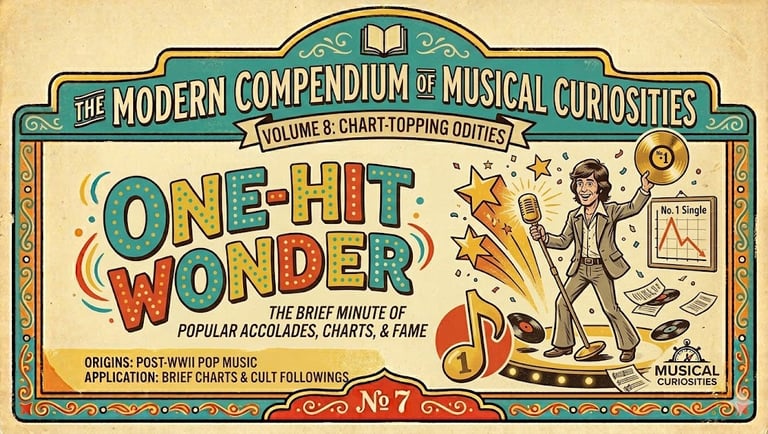
A term used to describe an artist, musician, or group that achieves massive, "800-pound gorilla" levels of success with a single popular song or work, but is never able to replicate that success again. In a broader sense, it refers to any entity—a business, an athlete, or even a piece of "junk" tech—that has one spectacular "license to print money" moment before fading into obscurity.
The Deep Dive
The "junk knowledge" behind the "one-hit wonder" is that it is a statistical anomaly of the recording industry. While it sounds like a failure of talent, it is often a "close shave" with the perfect storm of timing, marketing, and cultural "mood."
The Billboard Origin: The phrase solidified in the 1970's and 80's as music journalists began tracking the "Top 40" charts. A "hit" was defined as a song that cracked the Top 40. A "one-hit wonder" was an artist who peaked high (often at #1) and then "chickened out" of the charts forever.
The "Junk" of Saturation: Often, a one-hit wonder is a victim of its own success. If a song becomes a "flock" favorite—played on every radio station and in every grocery store—the public reaches "peak saturation." The artist becomes so synonymous with that one specific "junk" sound that the audience refuses to let them "color outside the lines" with their next project.
The "Novelty" Trap: Many one-hit wonders are "novelty acts." These are songs built on a "junk" gimmick, a specific dance (like the Macarena), or a timely joke. Once the joke is over, the "what’s done is done" finality of the trend kicks in, leaving the artist with a "tall order" to prove they are a serious musician.
The phrase reached peak "junk" status in the 1990's with the rise of VH1’s "100 Greatest One-Hit Wonders" specials. It represents the "junk" of fleeting fame: the reality that in the eyes of history, one massive success followed by nothing is often more memorable than a lifetime of being "consistently average."
Fast Facts
The "Flash in the Pan" Rival: This 17th-century idiom is the "one-hit wonder’s" grandfather. It refers to a flintlock musket where the gunpowder in the "pan" would flare up (the "flash"), but the main charge wouldn't fire. It was all show and no "load."
The "Penny Lane" Anomaly: Interestingly, some legendary bands are "one-hit wonders" in specific countries. For example, A-ha is a massive, multi-decade "800-pound gorilla" in Europe, but in the United States, they are the quintessential one-hit wonder for "Take On Me."
The Financial Reality: Being a one-hit wonder isn't a bad "brass tacks" deal. If you wrote the song yourself, the royalties from that one hit can provide a "license to print money" for the rest of your life, allowing you to "take a load off" without ever working again.
References
Jancik, W. (1998). The Billboard Book of One-Hit Wonders. Billboard Books.
VH1. (2002). 100 Greatest One-Hit Wonders. (Television Special).
Oxford English Dictionary. (2026). The Etymology of Pop Culture Superlatives.