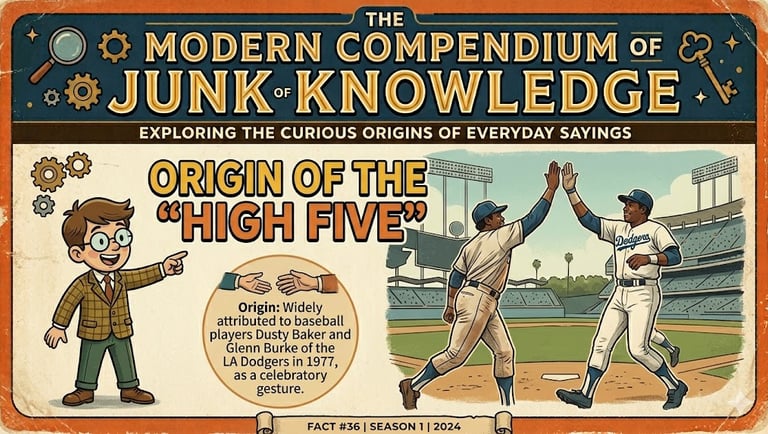
Origin of the "High Five"
The Definition
A celebratory hand gesture where two people simultaneously raise one hand each and slap their palms together. It is the universal signal for success, camaraderie, and "job well done." While it feels like it has existed forever, it is actually a relatively modern evolution of the "low five."
The Deep Dive
The "junk knowledge" behind the high five is that we can pinpoint its "birth" to a specific baseball game on October 2, 1977. Unlike many idioms that "scatter to the winds" of history, the high five was a spontaneous moment of athletic theater.
The Dusty Baker/Glenn Burke Moment: During the last game of the regular season, Dusty Baker of the Los Angeles Dodgers hit his 30th home run. As he crossed home plate, his teammate Glenn Burke was waiting for him. In the excitement, Burke raised his hand high over his head. Baker, not knowing what else to do, reached up and slapped it. "His hand was up in the air, and he was arching way back," Baker later said. "So I reached up and hit his hand. It seemed like the thing to do."
The "Low Five" Ancestry: Before 1977, the "low five" (or "giving skin") had been a staple of African American culture and the jazz scene since at least the 1920's. You can see it in films from the 1940's—a waist-level palm slap. The Dodgers "invented" the high five by simply taking that existing gesture and raising it to "high" altitude.
The "Six Degrees" of Louisville: A rival claim comes from the University of Louisville basketball team during the 1978-79 season. Players Wiley Brown and Derek Smith are often credited with popularizing the gesture on the court, which was then picked up by national television cameras. Whether it started in the dugout or on the court, it was the sports media of the late 70's that acted as the "wind" to scatter the gesture across the globe.
The high five reached peak "junk" status in the 1980's, becoming the mandatory ending for every cheesy movie montage. It represents the "junk" of human connection: a simple, wordless physical contract that says, "We both just saw that, and it was great."
Fast Facts
The "Missing Link": Glenn Burke, one of the creators of the high five, was also the first Major League Baseball player to be out to his teammates and management during his career. In a bittersweet bit of history, the gesture he helped create outlasted his career, which was cut short due to the prejudices of the era.
National High Five Day: Celebrated on the third Thursday of April, this "holiday" was started in 2002 by students at the University of Virginia. It’s the one day a year where "sticking your nose in" someone else's space to offer a slap is legally (or at least socially) encouraged.
The "Too Slow" Twist: The "High Five / Down Low / Too Slow" prank is the cynical younger brother of the gesture. It utilizes the "skin of your teeth" margin of a hand slap to trick the other person, proving that even the most positive gestures can be used for a "junk" prank.
References
Jonoo, S. (2011). The High Five. ESPN 30 for 30.
The New York Times. (1980). The New Handshake: The High Five.
Los Angeles Dodgers Archives. (2026). Dusty, Glenn, and the Birth of a Legend.