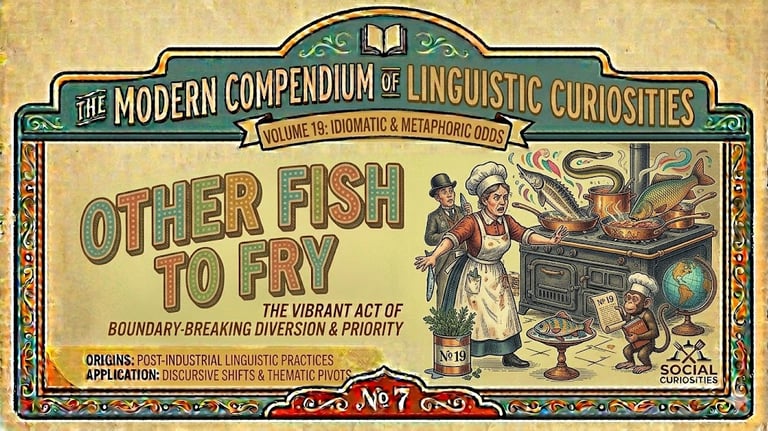
Other Fish to Fry
The Definition
This idiom is used to dismiss a person, a task, or a small problem in favor of something more important or urgent. It implies that the current matter is not worth the time or energy because there are "bigger" or more pressing concerns that require immediate attention.
The Deep Dive
While it sounds like a modern kitchen dismissal, this phrase has been part of the English language for over 300 years, appearing in both literary and colloquial contexts.
The Culinary Hierarchy: The phrase relies on the practical reality of cooking. If a cook has a variety of fish, they must prioritize the ones that are most valuable or likely to spoil. To say you have "other fish to fry" suggests that the current "fish" (the problem at hand) is a small or insignificant one, while the others waiting in the pan are the priority.
17th-Century Satire: One of the earliest recorded uses appears in the 1660 translation of Don Quixote, and later in the works of English satirists like John Evelyn. In these contexts, it was a polite but firm way to end a conversation or decline a request. It signaled that the speaker’s schedule was already saturated with more significant "junk" that needed sorting.
Dismissive Toned: Unlike some idioms that express regret, this one is often slightly dismissive. It suggests that the person or topic being pushed aside is small fry. It’s a way of signaling that you are operating on a different level of importance and cannot be bothered with minor distractions that might throw a "wrench in the works" of your larger plans.
Fast Facts
The "Bigger Fish to Fry" Variation: This is the most common version used today. It adds the word "bigger" to explicitly emphasize the disparity in importance between the current task and the one being prioritized.
Global Equivalence: Many cultures use food-based dismissals. In French, one might say J'ai d'autres chats à fouetter ("I have other cats to whip"), which, while much more violent, carries the exact same meaning of having more important business elsewhere.
References
Cervantes, M. (1605/1660 trans). Don Quixote.
Ammer, C. (2013). The Dictionary of Clichés. Skyhorse Publishing.
Oxford English Dictionary. (2026). Culinary Metaphors and Social Prioritization in Early Modern English.