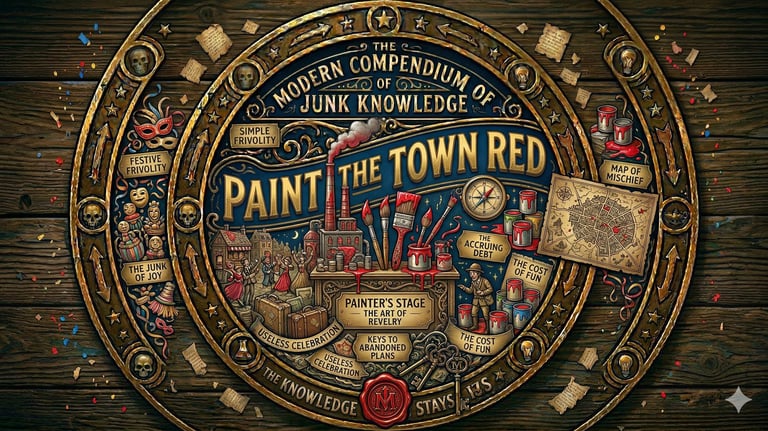
Paint the Town Red
The Definition
To go out and celebrate boisterously, flamboyantly, or recklessly. It implies a night of high-energy revelry, often involving a "spree" across multiple locations (bars, clubs, or parties) with a total disregard for the quiet of the morning.
The Deep Dive
This is a "high-pigment" piece of junk knowledge that bridges the gap between a literal 19th-century crime scene and American frontier slang.
The "Mad Marquess" (The Literal Legend): The most famous—and well-documented—origin story took place on April 6, 1837, in the English town of Melton Mowbray. Henry Beresford, the 3rd Marquess of Waterford (a notorious alcoholic and prankster known as the "Mad Marquess"), was celebrating with friends after the Croxton Park races. After being refused entry at a tollgate for being too drunk, the group found several pots of red paint being used for repairs. They proceeded to:
Paint the tollgate red.
Paint the doors and windows of several homes and the post office.
Paint a carved swan at the White Swan Inn (turning it into a "Red Eagle").
Daub the face and neck of a local constable who tried to stop them.
The American Connection (The Linguistic Reality): While the Marquess literally painted a town red, the phrase didn't actually appear in print for another 45 years—and when it did, it was in American newspapers (specifically in Kentucky and New York in the early 1880's).
The "Nose Paint" Theory: Etymologists suggest the American phrase might have been a play on "nose paint" or "nose rouge," which was 19th-century slang for cheap whiskey (referencing the red, flushed face of a heavy drinker). To "paint the town" was simply to spread that "red" energy everywhere.
The phrase gained massive popularity in the late 19th century as a description for cowboys "blowing their pay" in red-light districts. By the time it reached the 20th century, it had lost its violent or vandallous edge and became the universal term for a "night to remember."
Fast Facts
The Fine: The Marquess of Waterford and his friends were eventually brought to trial and fined £100 each—a massive sum at the time (over $12,000 today)—for what was described as an "Aristocratic Spree."
The "Scarlet" Precursor: Some link the phrase to Dante’s Inferno, which mentions those who "painted the world scarlet with sins," though there is no direct evidence this inspired the 1880's American slang.
The "Firework" Link: Early uses in New York City also referred to "painting the town red" with the literal red glare of Independence Day firecrackers and bonfires.
References
Alken, H. (1837). The Spree at Melton Mowbray. (Contemporary Illustration).
The New York Times. (1883, July). Political Revelry in Newark.
Ammer, C. (2013). The Dictionary of Clichés. Skyhorse Publishing.
The Oxford English Dictionary. (2026). Red (adj. and n.). Oxford University Press.