Pandora’s Box
The Definition
"Pandora’s box" is an idiom describing a process or action that, once initiated, unleashes a torrent of complex, uncontrollable, and unforeseen troubles. It represents a classic cautionary tale about the limits of human curiosity and the irreversible nature of certain decisions. Metaphorically, to "open Pandora’s box" is to trigger a chain reaction of disasters that can never be fully stuffed back into the origin.
The Deep Dive
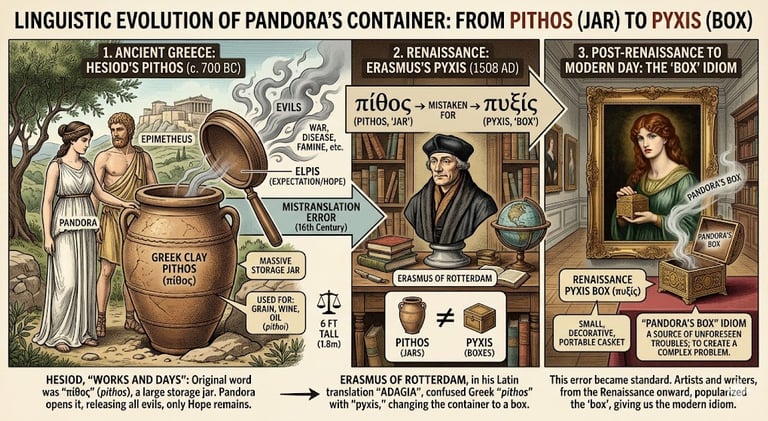
The phrase is a foundational pillar of Western mythology, yet its modern phrasing relies on a massive translation error committed by a 16th-century Renaissance scholar.
The Mythological Punishment: According to the ancient Greek poet Hesiod, Pandora was the very first human woman, created by Hephaestus on the orders of Zeus. Her creation was a calculated act of revenge against humanity after Prometheus stole the secret of fire. Zeus presented Pandora with a beautiful vessel as a wedding gift but strictly forbade her from ever looking inside.
The Irreversible Release: Driven by an intense curiosity, Pandora eventually slipped the lid off the container. Instantly, all the hidden miseries of the world—sickness, old age, war, famine, and death—flew out into the atmosphere, completely escaping human control. Terrified, Pandora slammed the lid back down, but it was too late; the only item left trapped at the very bottom of the vessel was Hope (Elpis).
The Cask vs. The Box: In Hesiod's original Greek text, the container was explicitly described as a pithos—a massive, coarse earthenware jar or storage cask used in the Mediterranean to hold grain, oil, or wine. These jars were often large enough to hide a adult human inside.
The Scholar's Slip: In the early 1500’s, the Dutch humanist Desiderius Erasmus translated Hesiod's tales into Latin. While working on the manuscript, Erasmus confused the Greek word pithos (jar) with pyxis, a small, decorative jewelry box or casket. Because of this single linguistic mistake, the image of a massive, immovable clay storage vessel was completely erased from the cultural imagination, replaced forever by the neat, portable "box" we refer to today.
Fast Facts
The Hope Contradiction: Philosophers have debated for centuries why Hope was trapped in a box full of evils. Some argue that Hope was preserved as a comfort for humanity, while others suggest that blind hope was actually the most dangerous evil of all, kept locked away so it wouldn’t drive humanity completely mad.
Modern Legal and Scientific Parallel: The term is frequently used by ethicists and scientists to describe breakthroughs in genetic engineering, artificial intelligence, or nuclear physics—where a single technological discovery could fundamentally alter human history with no way to reverse the process.
References
Hesiod. (c. 700 BCE). Works and Days.
Panofsky, D. & E. (1956). Pandora's Box: The Changing Aspects of a Mythical Symbol. Princeton University Press.
Oxford English Dictionary. (2026). The Renaissance Translation and Onomastic Evolution of Classical Mythological Idioms.