Pay the Piper
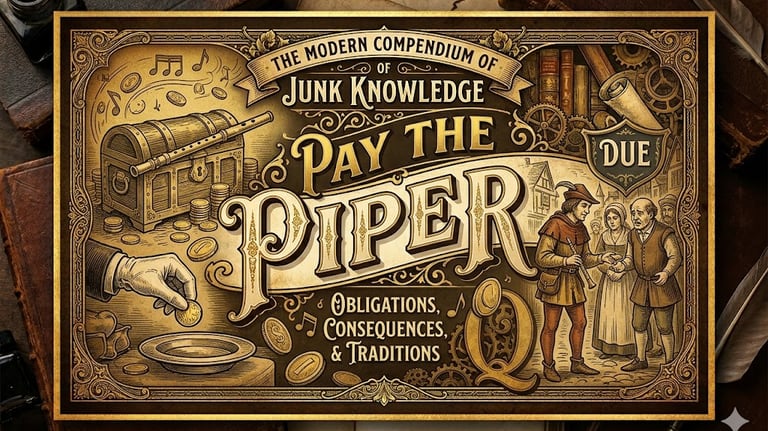
The Definition
To face the consequences of one's actions, especially after a period of self-indulgence or ignoring a mounting problem. It implies that the "fun" is over and the bill—which may be quite steep—has finally come due.
The Deep Dive
This is a "high-stakes" piece of junk knowledge that traces back to one of the most unsettling legends in Western history: The Pied Piper of Hamelin. While we now use it to describe a credit card bill or a political scandal, the origin is a literal 13th-century breach of contract.
The Legend (1284 AD): The town of Hamelin, Germany, was suffering from a massive rat infestation. A man dressed in multicolored ("pied") clothing appeared and offered to rid the town of the vermin for a specific fee.
The Magic Flute: The Piper played a secret melody, and the rats followed him into the River Weser, where they drowned.
The Default: When the Piper returned for his payment, the townspeople—having seen the rats were gone—refused to pay, claiming the price was too high for "merely playing a tune."
The Payment: In retaliation, the Piper returned on June 26th. He played a different tune, and this time, 130 of the town's children followed him out of the city and into a mountain cave, never to be seen again.
The phrase "he who pays the piper calls the tune" (meaning the person funding an endeavor gets to decide how it's done) appeared in the 17th century. However, the shortened "pay the piper" became the defining metaphor for "inevitable consequences" by the Victorian era. It serves as a grim reminder that no service—especially a "magical" one—is ever truly free.
Fast Facts
The Historical Core: Unlike many fairy tales, the Pied Piper has a historical basis. An inscription on the town hall of Hamelin (dated 1300) actually recorded the "departure of our children" in 1284. Modern historians suggest it may refer to a "Children's Crusade" or a mass emigration to settle lands in Transylvania.
The "Pied" Clothing: "Pied" comes from the word "magpie," referring to a garment made of many different colored patches—the traditional uniform of a traveling minstrel or a professional rat-catcher.
The First Print: While the legend is ancient, the exact English idiom "to pay the piper" began appearing in political pamphlets in the 1800's to describe the "hidden costs" of war and taxation.
References
Browning, R. (1842). The Pied Piper of Hamelin. (Poem).
Grimm, J. & W. (1816). German Legends. (No. 245, The Children of Hamelin).
Ammer, C. (2013). The Dictionary of Clichés. Skyhorse Publishing.
The Oxford English Dictionary. (2026). Piper (n.1). Oxford University Press.