Pearls Before Swine
The Definition
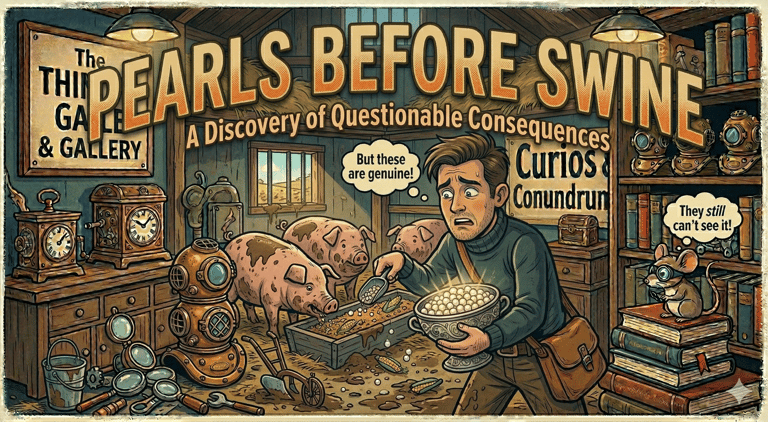
To offer something valuable, beautiful, or profound to someone who is unable to appreciate its worth. It suggests a waste of effort where the recipient's lack of refinement or understanding leads them to ignore or even destroy the gift.
The Deep Dive
This phrase is nearly 2,000 years old, originating from the Sermon on the Mount in the New Testament (Matthew 7:6). While it sounds like a simple agricultural metaphor, the "junk knowledge" often misses the specific cultural and physical imagery intended in the original Greek and Aramaic.
The verse reads: "Give not that which is holy unto the dogs, neither cast ye your pearls before swine, lest they trample them under their feet, and turn again and rend you."
The Physical Confusion: To a pig, a pearl looks remarkably like a dried pea or a bit of maize. A hungry swine, expecting food, would eagerly approach the "pearls." Upon realizing the objects are hard, inedible stones, the pig becomes frustrated and aggressive.
The "Rend You" Clause: The warning isn't just that the pearls will be lost; it’s that the swine, feeling cheated of a meal, will turn their aggression toward the person who offered the "fake" food.
In the 16th century, the phrase was popularized in English by William Tyndale's Bible translation. It eventually moved beyond religious teaching to become a secular shorthand for any situation where high-quality work (art, music, or complex ideas) is presented to an audience that prefers the "slop" of the mundane.
Fast Facts
The Value Gap: In the ancient world, pearls were arguably more valuable than diamonds because they required no cutting or polishing; they were "perfect" the moment they were found.
The "Holy" Dogs: The first half of the verse ("Give not that which is holy unto the dogs") refers to the sacrificial meat from the Temple, which was considered too sacred to be tossed to scavengers.
The Comic Strip: The phrase is the namesake of the popular comic strip Pearls Before Swine by Stephan Pastis, which features a character named "Pig" who often fails to understand the "pearls" of wisdom offered by others.
References
The Bible. (King James Version). Matthew 7:6.
Tyndale, W. (1526). The New Testament. (First English translation from Greek).
Ammer, C. (2013). The Dictionary of Clichés. Skyhorse Publishing.
Manser, M. H. (2007). The Facts on File Dictionary of Proverbs. Facts on File.