Pepper's Ghost
The Definition
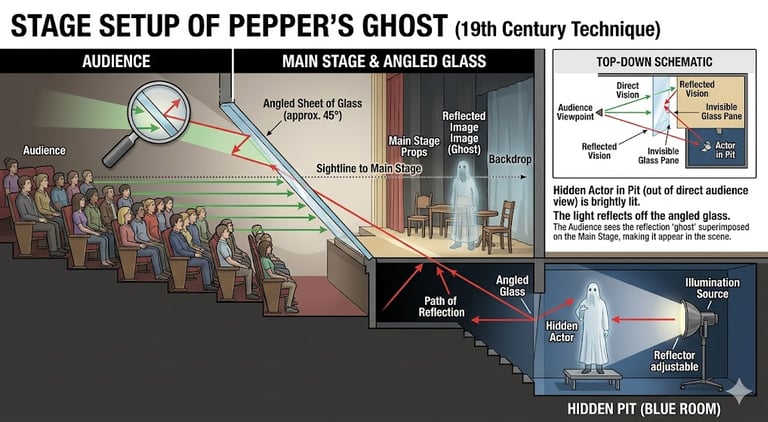
Pepper’s Ghost is an illusion technique used in theater, amusement parks, and museums to make a translucent, ethereal figure appear and disappear out of thin air. By using a carefully angled sheet of glass and precise lighting, the technique projects the reflection of a hidden object onto a main stage, seamlessly blending a "ghost" into a live-action scene.
The Deep Dive
While the illusion bears the name of an English scientist, its true history is a tale of a forgotten inventor, a dramatic theatrical heist, and the fundamental physics of light reflection.
The Dircksian Blueprint: In 1858, a civil engineer named Henry Dircks invented the "Dircksian Phantasmagoria." He realized that if you placed a large pane of glass at a 45 degree angle between an audience and a stage, the glass would act as a partial mirror. If you kept a side room completely dark, the audience could see straight through the glass to the main stage. But if you suddenly illuminated an actor hidden in that side room, their reflection would magically appear on the glass, looking like a transparent spirit walking among the live actors.
The Pepper Pivot: Dircks tried to sell his idea to theaters, but it required completely remodeling their stages, so everyone passed. Enter John Henry Pepper, a charismatic chemist and director of the Royal Polytechnic Institution in London. In 1862, Pepper saw Dircks's model and realized it could be easily adapted to existing theaters by putting the hidden actor in a sunken orchestra pit below the stage rather than a separate side room.
The Christmas Debut: On Christmas Eve in 1862, Pepper debuted the illusion during a production of Charles Dickens’s The Haunted Man. The audience was utterly spellbound as a glowing, transparent ghost materialized on stage and interacted with the living actors. Pepper tried to give Dircks co-credit, but the public and the press instantly dubbed the sensation "Pepper's Ghost"—a name that infuriated Dircks and stuck permanently in the lexicon.
The Modern Metaphor: Beyond the stage, "Pepper's Ghost" has become a valuable metaphor in media and technology studies for an illusion of presence. It represents any situation where two distinct realities—one real and one entirely manufactured—are superimposed so perfectly that the viewer cannot tell where the physical world ends and the reflection begins.
Fast Facts
The Haunted Mansion: The most famous modern use of Pepper's Ghost is inside Walt Disney World’s Haunted Mansion ride. In the grand ballroom scene, dozens of translucent ghosts are seen dancing and swinging from chandeliers. The effect is achieved entirely with massive physical glass panes and real animatronics hidden directly beneath and above the ride vehicles.
The "Hologram" Hoax: The famous "holograms" used to bring deceased musicians (like Tupac Shakur at Coachella or Michael Jackson) back to live stages are not holograms at all. They are high-tech, digital variations of Pepper's Ghost, utilizing ultra-thin, transparent Mylar foil stretched at a 45 degree angle to reflect high-powered laser projectors hidden in the stage rigging.
References
Pepper, J. H. (1890). The True History of Pepper's Ghost. Cassell & Co.
Steinmeyer, J. (2003). Hiding the Elephant: How Magicians Invented the Impossible and Learned to Disappear. Carroll & Graf.
Oxford English Dictionary. (2026). The Mechanics of Victorian Stage Illusion and Optical Catoptrics.