Pet Rock
The Definition
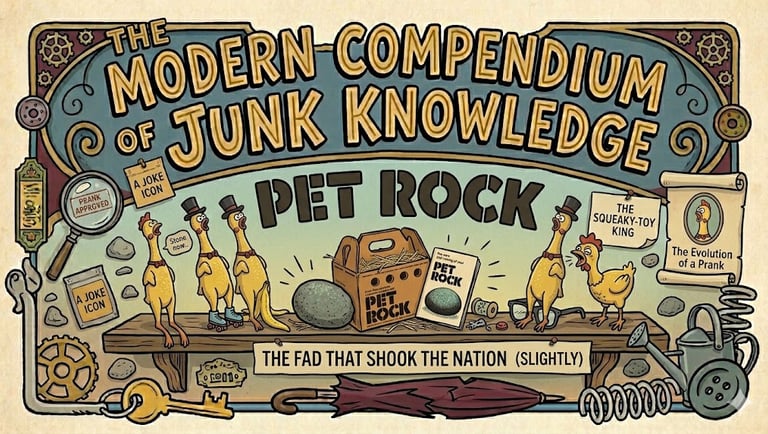
A smooth stone from Mexico's Rosarito Beach, packaged in a cardboard box with air holes and a straw nest, marketed as a "pet" that required no feeding, grooming, or walking. It remains the definitive example of a "fad"—a product that sells millions based purely on a clever concept rather than utility.
The Deep Dive
The "junk knowledge" behind the Pet Rock is that the customer wasn't actually buying a rock; they were buying a joke. In 1975, Gary Dahl, a freelance copywriter, was sitting in a bar in Los Gatos, California, listening to his friends complain about the hassles of owning real pets. He joked that his "pet" was a rock.
The Instruction Manual: The true product was the 36-page booklet titled The Care and Training of Your Pet Rock. It used a deadpan, pseudo-scientific tone to explain how to make the rock "sit," "stay," and "roll over" (with the owner's help). It included chapters on "Initial Training" and "Reproduction."
The Packaging Genius: Dahl understood that the "theatre" of the product was everything. By putting a common stone in a carrier designed like a pet crate—complete with a bed of excelsior (wood shavings)—he transformed a worthless object into a "collectible."
The Six-Month Empire: The Pet Rock was only on the market for about six months during the 1975 holiday season. In that time, Dahl sold over 1.5 million rocks for $3.95 each. Because the rocks cost virtually nothing to source and the packaging was cheap, Dahl became an overnight millionaire before the fad vanished as quickly as it arrived.
The Pet Rock reached peak "junk" status as a symbol of 1970's consumer absurdity. It represents the "junk" of marketing psychology: the "I-can't-believe-people-are-buying-this" factor. It proved that if you wrap a mundane object in enough personality and humor, people will pay for the feeling of being "in on the joke."
Fast Facts
The Source: The rocks were actually stones gathered from beaches in Mexico. Dahl bought them for a few cents each from a local supplier who used them for landscaping.
The "Sand" Sequel: Following his success, Dahl tried to market "Sand Breeding Kits" (vials of sand that would allegedly "mate" to create more sand), but the public’s appetite for high-concept dirt had already been satiated.
The Re-Issue: Despite being a 1970's relic, the Pet Rock brand was revived in the 2010's by Rosebud Entertainment, proving that every generation has a segment of the population looking for a low-maintenance companion.
References
Dahl, G. (1975). The Care and Training of Your Pet Rock.
The New York Times. (2015). Gary Dahl, Inventor of the Pet Rock, Dies at 78.
Smithsonian Magazine. (2026). The Cultural Impact of the 1970s Fad.