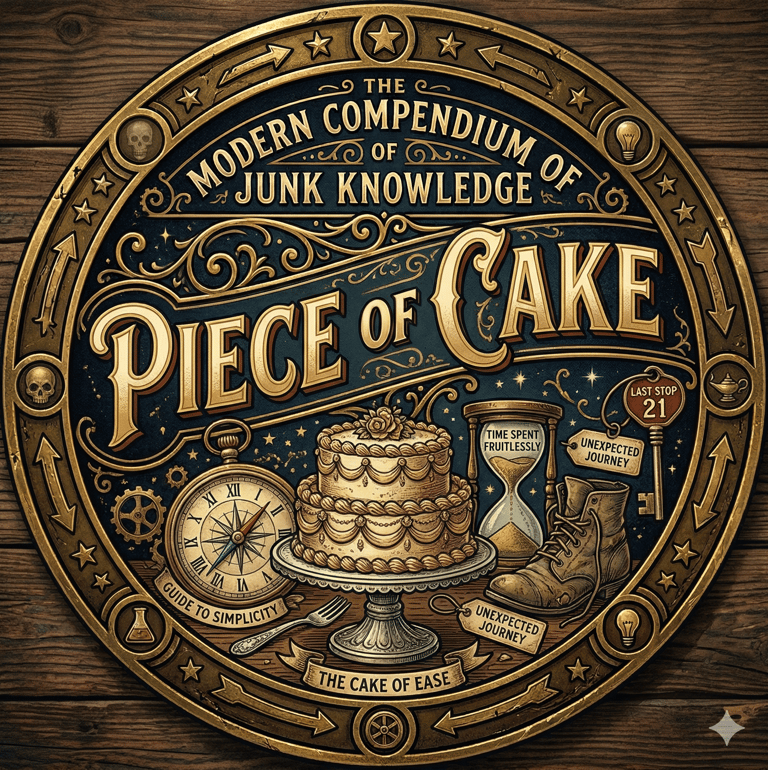
Piece of Cake
The Definition
Something that is extremely easy to accomplish; a task that requires little effort and results in a pleasant outcome. It is the culinary cousin to "easy as pie," implying that the process is as enjoyable as the reward.
The Deep Dive
This is a "high-sugar" piece of junk knowledge from the complex social history of the American South (c. 1850–1870). While we now use it for a simple math problem or a quick home repair, the origin is a literal, high-stakes performance known as the "Cakewalk."
The Promenade: On plantations, enslaved people would hold competitions where couples would walk in a stylized, high-stepping "procession," mimicking and subtly mocking the stiff, formal ballroom dancing of the white plantation owners.
The "Easy" Prize: The couple that performed the most graceful or inventive walk was declared the winner. The prize? A highly coveted, elaborate cake.
The Linguistic Shift: To the observers, the actual walking wasn't seen as "labor"—it was a dance, a celebration. Winning the prize was seen as "taking the cake." Consequently, any task that was easily won or performed with a sense of flair became known as a "cakewalk" or, eventually, a "piece of cake."
While the "Cakewalk" provided the cultural foundation, the exact phrase "piece of cake" didn't fully "bake" in the English lexicon until the 1930's. It was popularized by the Royal Air Force (RAF) during World War II. Pilots used it to describe a mission that encountered no enemy resistance—a "flight" that was as easy and pleasant as sitting down to a dessert.
Fast Facts
The "Take the Cake" Link: This is a direct linguistic sibling. In the original cakewalks, the winners literally "took the cake" home as their trophy.
The "Easy as Pie" Contrast: While a "piece of cake" refers to the ease of the task, "easy as pie" (a 19th-century Americanism) originally referred to how easy a pie is to eat, not necessarily to bake.
The First Print: The specific wording "piece of cake" appeared in the 1936 book The Primrose Path by Ogden Nash: "Her strategy was a piece of cake."
References
Nash, O. (1936). The Primrose Path. (Simon & Schuster).
Stearns, M. & J. (1968). Jazz Dance: The Story of American Vernacular Dance. Macmillan.
Ammer, C. (2013). The Dictionary of Clichés. Skyhorse Publishing.
The Oxford English Dictionary. (2026). Cake (n.1). Oxford University Press.