Piggy Bank
The Definition
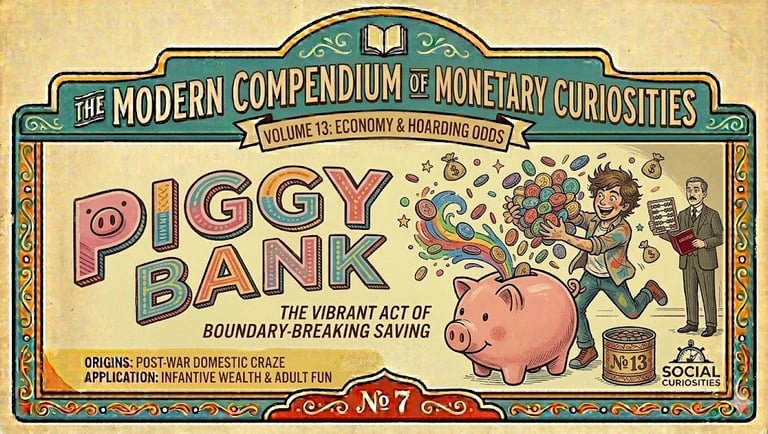
A "piggy bank" is a container—traditionally shaped like a pig—used to store loose change. It serves as a fundamental tool for teaching children the concept of saving and financial patience, representing a secure place where small amounts of "junk" change can accumulate into a significant sum.
The Deep Dive
The association between pigs and savings is actually a linguistic accident rather than a tribute to the animal's financial savvy.
The "Pygg" Confusion: In Middle English, a specific type of orange-colored, economical clay was known as pygg. During the 15th century, potters used this cheap material to create household items like jars, dishes, and—most importantly—money boxes. These were referred to as "pygg jars."
Visual Evolution: As the English language evolved, the word for the clay (pygg) and the word for the animal (pig) merged in pronunciation. By the 18th and 19th centuries, potters began playing on this homophone, shaping their clay money boxes into the form of actual pigs. The visual pun became so popular that it eventually became the standard for coin banks worldwide.
The "Sacrificial" Bank: Originally, piggy banks did not have a hole in the bottom. This was a deliberate design feature; to retrieve the money, the child had to literally break the pig. This taught the lesson that savings should only be accessed for a major purpose or when the "vessel" was completely full, adding a sense of finality and gravity to the act of spending.
Fast Facts
Ancient Precedents: While the "pygg" clay theory is the most prominent, coin banks shaped like pigs have been found in Indonesia dating back to the 14th-century Majapahit Empire, suggesting that the pig's association with fertility and abundance made it a natural choice for wealth-storage symbols across different cultures.
The Plastic Plug: The modern rubber or plastic plug at the bottom of the bank is a 20th-century invention that removed the "breaking" requirement, making the banks reusable but arguably less effective at teaching extreme patience.
References
Ammer, C. (2013). The Dictionary of Clichés. Skyhorse Publishing.
Ayto, J. (1990). Dictionary of Word Origins. Arcade Publishing.
Oxford English Dictionary. (2026). The Etymology of Medieval Domestic Ceramics.