Plug Nickel
The Definition
A plug nickel (often phrased as "not worth a plugged nickel") is an idiom used to describe something that is completely worthless, fraudulent, or of no practical value. It serves as a classic linguistic benchmark for measuring total financial or qualitative insignificance.
The Deep Dive
The phrase is a literal artifact from the golden age of American counterfeiting and coin tampering during the 19th century.
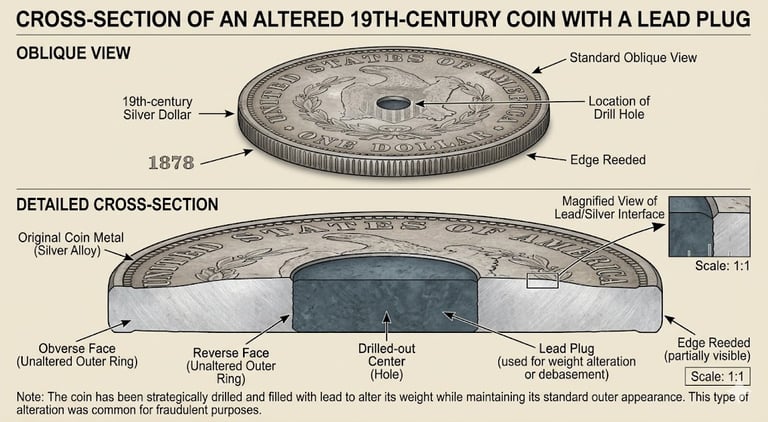
The Anatomy of the Tamper: In the 1800’s, coins were minted using precious or semi-precious metals. Dishonest merchants and criminals devised a method to strip value from currency without changing its outer dimensions. They would take a high-quality coin, drill or punch out the valuable metal center, and melt down the shavings for profit.
Inserting the "Plug": To make the defaced coin usable in everyday commerce, the counterfeiter would fill the newly created hole with a cheap, base metal—such as lead, tin, or copper. This replacement material was known as the "plug." The coin was then smoothed down and re-stamped to look like a solid, unvarnished piece of legal tender.
The Detection Failure: While a "plugged" silver dollar or gold piece was a devastating financial hit to a merchant, the phrase eventually settled heavily on the nickel. When the US Mint introduced the five-cent nickel coin in 1866, it was already made of cheap base metals (a copper-nickel alloy) rather than precious silver. Therefore, a nickel that had been drilled out and plugged with lead was doubly worthless—it wasn’t worth the time it took to forge, and no merchant with an unvarnished eye would accept it once the soft lead plug inevitably discolored or popped out.
The Idiomatic Shift: By the late 1800’s, the phrase passed from the retail counter into general slang. To say an opinion, a contract, or a person's word was "not worth a plugged nickel" meant it was a counterfeit promise—hollowed out from the inside and filled with junk.
Fast Facts
The "Wooden Nickel" Cousin: While a plugged nickel refers to a real coin that was altered and debased, a "wooden nickel" represents a completely fake, novelty token, giving rise to the parallel warning: "Don't take any wooden nickels."
The Ring Test: Experienced bank clerks and saloon keepers could instantly spot a plugged coin by dropping it onto a hard wooden counter. A genuine, solid coin produced a clear, melodic ring, while a coin with a soft lead plug made a dull, hollow thud.
References
Mencken, H. L. (1936). The American Language. Alfred A. Knopf.
Ammer, C. (2013). The Dictionary of Clichés. Skyhorse Publishing.
Oxford English Dictionary. (2026). The Numismatic Etymology of Fractional Currency and Counterfeiting Slang.