Poison Pill
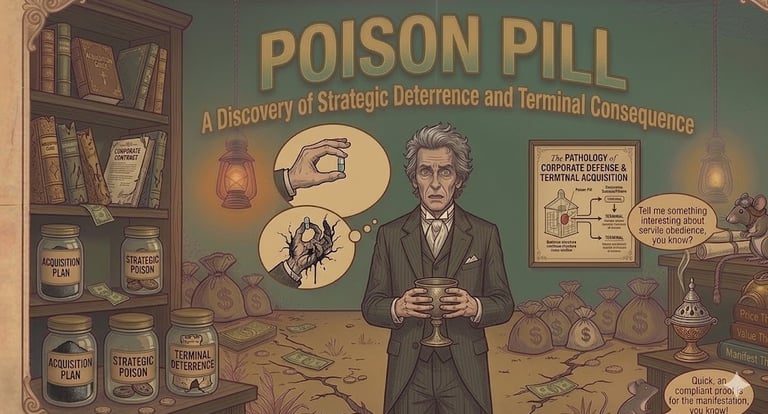
The Definition
A poison pill is a defensive strategy used by a company’s board of directors to prevent an hostile takeover by another corporation or activist investor. By triggering specific corporate mechanisms, the company deliberately makes its own stock less attractive, cost-prohibitive, or financially devastating to the acquirer. Metaphorically, it refers to an unappealing clause, condition, or tactical move intentionally inserted into a negotiation or piece of legislation to kill a deal or force an opponent to withdraw.
The Deep Dive
The term bridges the gap between cold-war espionage tradecraft and the aggressive corporate raider era of 1980’s Wall Street.
The Espionage Origin: The literal "poison pill" (or lethal cavity cap) was a real tool used by mid-20th-century spies and captured soldiers. Agents carrying top-secret information were sometimes issued a small capsule containing a fast-acting toxin, such as potassium cyanide. If caught behind enemy lines with no hope of escape, the agent could swallow the pill—choosing self-destruction over interrogation to ensure the larger organization's secrets remained protected.
The Wall Street Rebrand: The term slipped into the financial lexicon in 1982. Famed corporate defense attorney Martin Lipton invented a mechanism officially called a shareholder rights plan. At the time, aggressive corporate raiders were staging hostile takeovers of vulnerable companies, buying up majority shares, and stripping their assets. Lipton designed a legal blueprint that allowed a target company to essentially swallow its own financial cyanide rather than let a raider seize control.
The Flip-In Mechanism: The most common corporate poison pill is the "flip-in" strategy. The board passes a rule stating that if any single investor acquires a certain percentage of the company's stock (usually 10% to 15%) without prior board approval, a trigger pulls. Instantly, every other shareholder except the hostile investor is given the right to buy newly issued shares at a massive discount.
The Economic Devastation: This move instantly floods the market with cheap stock, diluting the hostile investor's ownership percentage and making the cost of acquiring the company astronomically expensive. The raider is left holding a massive, expensive stake in a company that has intentionally depreciated its own value to lock them out.
[Image diagram showing a hostile takeover attempt blocked by a shareholder rights plan triggering a massive dilution of stock value]
Fast Facts
The Twitter Precedent: The tactic remains a powerful modern corporate weapon. In 2022, Twitter’s board of directors deployed a classic Lipton poison pill to stall Elon Musk's initial hostile takeover attempt, capping his accumulation threshold at 15% to force a negotiated board settlement.
The Flip-Over Variant: In a "flip-over" poison pill, shareholders are given the right to buy the acquiring company's shares at a steep discount after the takeover is complete, poisoning the predator's own financial books from the inside out.
References
Lipton, M. (1983). Takeover Bids in the Target's Boardroom. Business Lawyer.
Chernow, R. (1990). The House of Morgan: An American Banking Dynasty and the Rise of Modern Finance. Atlantic Monthly Press.
Oxford English Dictionary. (2026). The Onomastic Shift of Espionage Terminology to Corporate Finance Jurisprudence.