Post-it Notes
The Definition
Small squares of paper with a re-adherable strip of adhesive on the back, designed for temporarily attaching notes to documents and other surfaces. It is the ultimate "low-tech" survival tool of the modern office, doubling as a brainstorming medium, a bookmark, and a physical reminder in a digital world.
The Deep Dive
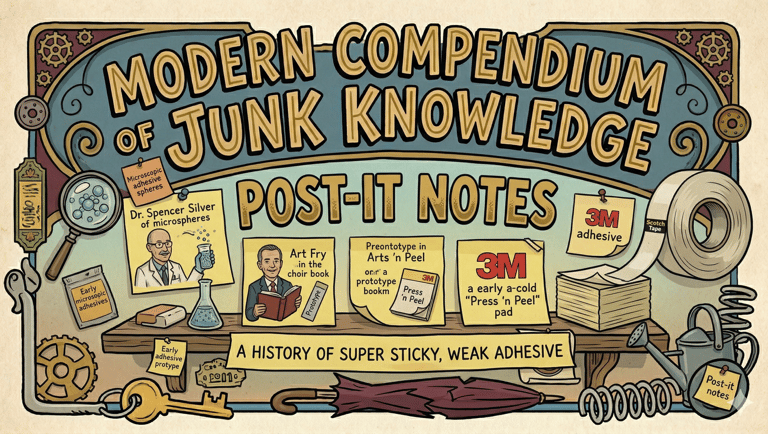
The "junk knowledge" behind the Post-it Note is that it is a masterpiece of "serendipitous failure." Like Bubble Wrap, it was the result of a product that failed to do what it was originally designed for. In 1968, Dr. Spencer Silver, a scientist at 3M, was attempting to develop a super-strong adhesive for the aerospace industry.
The Failed Glue: Instead of a permanent bond, Silver created "microspheres"—tiny, acrylic bubbles that were sticky enough to hold onto a surface but small enough to be peeled off without leaving a residue. For five years, he promoted this "solution without a problem" within 3M, but no one saw a use for a glue that didn't actually stick things together permanently.
The Hymnbook Breakthrough: In 1974, another 3M scientist, Art Fry, was frustrated during choir practice. The paper bookmarks in his hymnbook kept falling out. He remembered Silver’s "weak" adhesive and realized it was the perfect way to anchor a bookmark without damaging the pages.
The Iconic Yellow: The classic "Canary Yellow" color of the original Post-it Notes was also an accident. The lab next door to the Post-it team happened to have a scrap pile of yellow paper. Since they were on a budget, they used the yellow scraps for their first tests, and the color became so synonymous with the brand that they never changed it.
Post-it Notes reached peak "junk" status in the early 1980's. After a massive sampling campaign known as the "Boise Blitz," where 3M gave away pads to every office in Boise, Idaho, the company found a 90% reorder rate. It represents the "junk" of the creative process: the idea that a "mistake" is only a mistake until you find the right context for it.
Fast Facts
The "Glue" Science: Technically, Post-it adhesive doesn't "dry." It is a pressure-sensitive adhesive that maintains its tack because the microspheres only make contact with a fraction of the surface area, allowing it to be lifted and moved repeatedly.
The Art of the Post-it: In 2000, to celebrate the 20th anniversary, an artist named R.B. Kitaj created a Post-it Note pastel drawing that sold at auction for over $900.
The 3M Patent: The patent for the "pressure-sensitive adhesive" expired in the 1990's, which is why you now see "sticky notes" from dozens of different brands, though "Post-it" remains the generic trademark used by most of the world.
References
3M Corporate Archives. (2026). The Silver and Fry Legacy.
Petroski, H. (1992). The Evolution of Useful Things. Alfred A. Knopf.
Fry, A. (1980). U.S. Patent No. 4,191,405.