Proof is in the Pudding
The Definition
A shorthand expression meaning that the true value, quality, or truth of something can only be judged by putting it into practice or experiencing the end result. It is the ultimate "results-oriented" idiom, suggesting that talk is cheap and the only thing that matters is the final "taste."
The Deep Dive
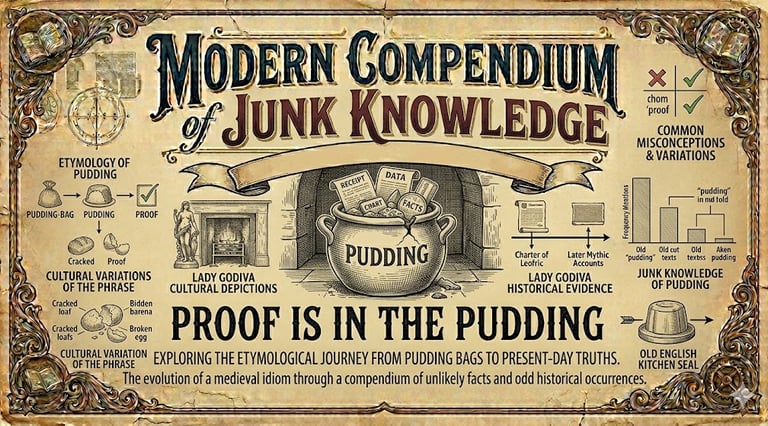
The "junk knowledge" trap here is a classic case of idiomatic erosion. Most people today say, "The proof is in the pudding," which, if you think about it, makes very little sense. Why would "proof" (evidence) be hidden inside a dessert?
The original, much more logical 14th-century version was: "The proof of the pudding is in the eating."
The Medieval Meat-Pudding: In the 1300s, a "pudding" wasn't a sweet chocolate treat. It was a savory dish, similar to a sausage (like black pudding), made by stuffing minced meat, cereal, and spices into an animal’s intestines.
The Gastronomic Gamble: Because there were no health inspectors or refrigeration, a pudding was a literal gamble. It might look perfectly fine on the outside, but it could be rotten or poorly seasoned on the inside. You couldn't know if it was a success or a source of food poisoning until you actually took a bite.
The Linguistic Shortcut: Over the centuries, the "is in the eating" part was lopped off for brevity. By the 1920's, the shortened "Proof is in the pudding" became the standard American version, effectively turning a practical cooking tip into a slightly nonsensical mystery.
The phrase reached peak "junk" status in the world of mid-century business and politics. It serves as the definitive rebuttal to anyone making a grand promise: "Don't tell me how good the plan is; let me see the results." It represents the "junk" of human skepticism—the refusal to believe the hype until the product is on the plate.
Fast Facts
The "Proof" Pivot: In this context, "proof" doesn't mean "evidence" in the legal sense, but rather "test" or "trial" (similar to "waterproof" or "bulletproof"). You are testing the pudding by eating it.
The Cervantes Connection: While the idea is ancient, one of its first major literary appearances was in the 1600's English translation of Don Quixote, helping to cement the phrase in the Western canon.
The 17th-Century Standard: By the 1600's, the phrase was so common that it appeared in William Camden's Remains Concerning Britain as a "standard proverb" for the common man.
References
Camden, W. (1605). Remains Concerning Britain.
Cervantes, M. (1605/1615). Don Quixote. (Trans. Shelton/Motteux).
Ammer, C. (2013). The Dictionary of Clichés. Skyhorse Publishing.
The Oxford English Dictionary. (2026). Pudding (n.). Oxford University Press.