Pull Out all the Stops
The Definition
To exert the maximum effort possible to achieve a goal; to use all available resources without restraint. It implies a "go big or go home" mentality where nothing is held back.
The Deep Dive
While modern users might think this refers to "stopping" a car or a process, the origin is purely acoustic. It comes from the complex world of the pipe organ, the most powerful and technologically advanced instrument of the pre-industrial age.
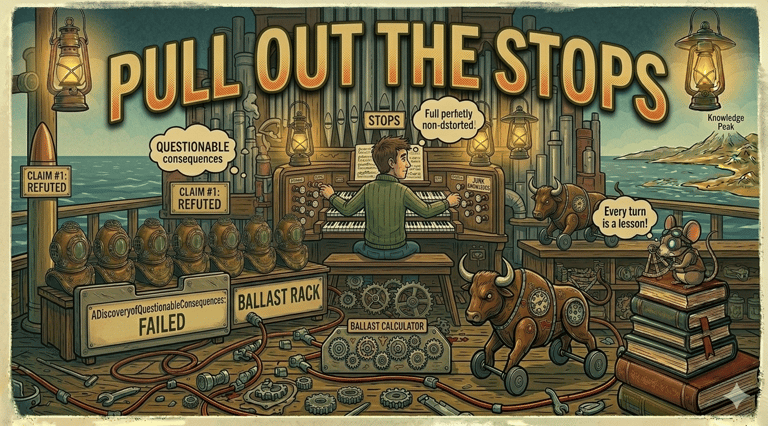
An organ creates sound by blowing air through pipes of different sizes and materials. To control which sets of pipes (ranks) receive air, the organist uses small handles called stops.
The Silent Pipe: When a stop is pushed in, it blocks the air from reaching a specific set of pipes. This allows the organist to play softly or change the "voice" of the instrument (making it sound like a flute, an oboe, or a trumpet).
The Full Chorus: To achieve the maximum possible volume and the richest, most thunderous sound, the organist must literally "pull out all the stops." This opens every air channel, engaging every single pipe in the organ at once.
The phrase moved from the cathedral to the common tongue in the mid-19th century. It was first used as a metaphor for intense emotional or rhetorical effort, famously appearing in the works of Matthew Arnold and other Victorian writers to describe a "full-throttle" performance.
Fast Facts
The Physicality: In massive cathedral organs, pulling out every stop requires significant physical reach and can make the entire building vibrate.
The "Grand Choeur": In French organ tradition, this state is known as Grand Choeur or Plein Jeu—the "Full Game."
The Mechanical Limit: If an organist pulls out all the stops but the "bellows" (the air supply) isn't strong enough, the instrument will actually drop in pitch—a musical "brownout."
References
Arnold, M. (1865). Essays in Criticism. Macmillan & Co.
Audsley, G. A. (1905). The Art of Organ-Building. Dodd, Mead & Co.
Jeans, P. D. (2004). Ship to Shore: A Dictionary of Pictorial Maritime Grammar. (Referencing the transition to general idioms).
Thistlethwaite, N. (1999). The Cambridge Companion to the Organ. Cambridge University Press.