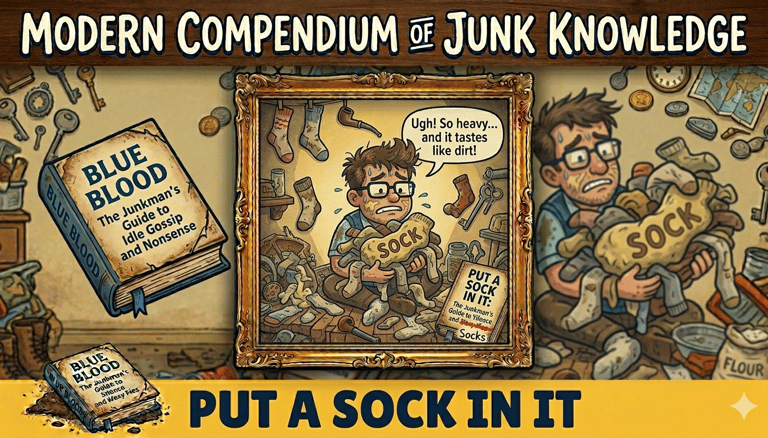
Put a Sock in It
The Definition
A colorful, slightly rude way to tell someone to be quiet or stop talking. It implies that the person’s noise is so intrusive that a physical "plug" is required to stop the sound at its source.
The Deep Dive
The "junk knowledge" surrounding this phrase is a classic battle between the barracks and the parlor. While many assume it’s a simple reference to stuffing a sock in a loudmouth’s face, the most popular origin story is tied to the early days of mechanical music.
Before the invention of the electronic volume knob, the early 20th-century gramophone (like the Victor Victrola) had a major design flaw: it was incredibly loud. The sound was amplified through a large internal or external horn, and there was no way to "turn it down" for late-night listening.
The Woolen Mute: To dampen the volume, listeners would take a thick wool sock and stuff it into the throat of the horn. This would muffle the vibrations and lower the decibels, allowing the music to play without waking the neighbors.
The "Sock" Command: If someone was being particularly boisterous or if the music was too loud for the room, the cry went out to "put a sock in it!"
However, etymologists point to a grittier origin in the British military during World War I. Soldiers living in cramped quarters or trenches often had to deal with loud snorers or "chatterboxes" who put the unit at risk. In these high-tension environments, a literal sock—often dirty and conveniently at hand—was the most effective tool for immediate silence. The phrase first appeared in print in the British weekly The Tatler in 1919, described as a popular piece of "trench slang."
Fast Facts
The "Victrola" Legend: While the gramophone story is the most charming, many Victrolas actually came with "volume doors" that could be opened or closed to muffle the sound, suggesting the "sock" was a DIY solution for cheaper models.
The First Print: The 1919 Tatler quote reads: "The ultimate expression of the 'shut up' school is 'put a sock in it.'"
The "Cork" Alternative: A similar (though less common) 19th-century phrase was "cork it," referring to the airtight seal of a wine bottle.
References
The Tatler. (1919, August 6). Current Slang of the Week.
Ammer, C. (2013). The Dictionary of Clichés. Skyhorse Publishing.
Read, O., & Welch, W. L. (1976). From Tin Foil to Stereo: Evolution of the Phonograph. Howard W. Sams & Co.
The Oxford English Dictionary. (2026). Sock (n.1). Oxford University Press.